
Clinic website design in Malta
Another trust-led site: what patients check and the rules that apply.
Websites · Trades
When a socket fails or a wall needs knocking down, people search on their phone and call the first business that looks real. This guide shows what a trade website needs, which licence facts to show, and the form that turns visitors into jobs.
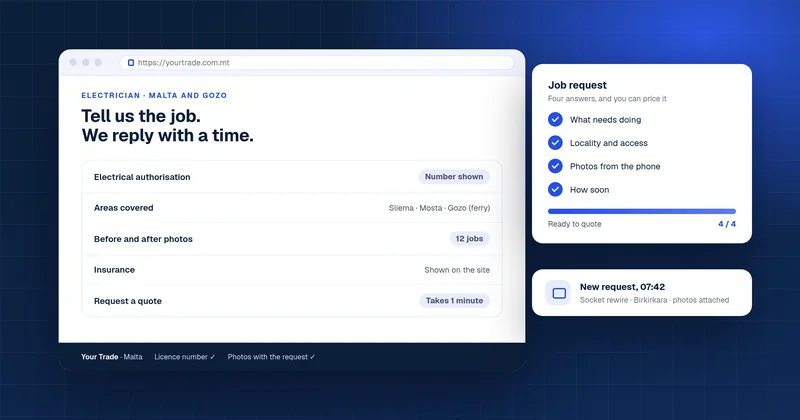
A trade website in Malta works when it shows what you do, where you work, your licence number and real photos of past jobs, and it ends in a short request form that asks for the job, the locality and how soon. Malta Digital builds these as part of its web design in Malta service, from €990.
First impressions
Most trade jobs begin with a worry: a tripping fuse board, a leak or a quote that feels too high. The customer searches, opens two or three sites and picks the one that feels real.
They look for four things in about ten seconds. Does this business do my job? Does it work in my locality? Is it properly qualified? Can I ask for a price without a long phone call?
A Facebook page can answer some of this. A website answers all of it in one place, at the address you own. See whether a Facebook page is enough if you are not sure.
Structure
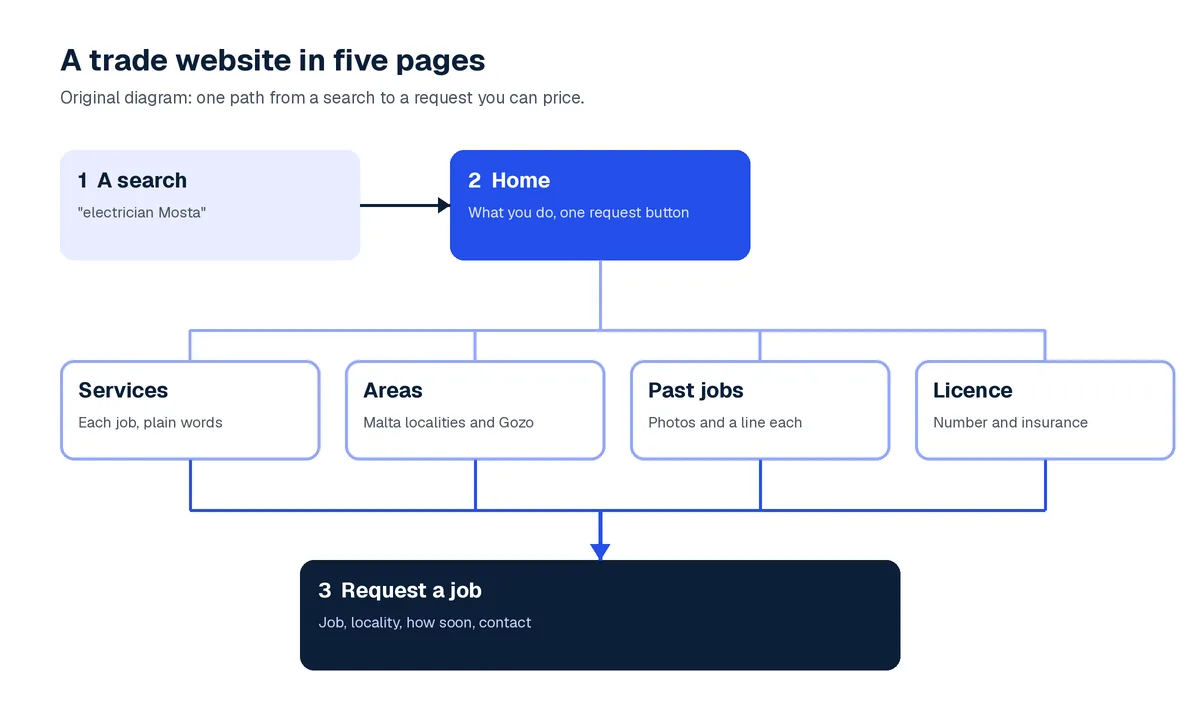
You do not need twenty pages. You need five clear ones that lead to one action. This is the path a customer follows on a good trade site.
Want these five pages built for your trade? Apply now for a trade website
Trust
Customers trust a number they can check. We read the Regulator for Energy and Water Services (REWS) page for electricians and the Construction Industry Licensing Regulations on 9 November 2026. This is what they say, in short.
| Trade | What the rule says | What to show on your site |
|---|---|---|
| Electricians | REWS issues Authorisation A (single-phase installations) and Authorisation B (single or three-phase installations up to 300 amps per phase) under the Electrical Installations Regulations, S.L. 545.24. Fees: €35 (A) or €70 (B) every three years. | Authorisation type and number, as on your card, plus insurance |
| Building, demolition, excavation | Under L.N. 166 of 2023, demolition, excavation and piling, and construction need a licence. Working without one can mean up to six months in prison, a fine up to €50,000, or both. | Licence number, the activity it covers, plus insurance |
| Other trades | Rules differ by trade, and some work needs a warrant or a registration. Check with the authority for your trade. | Any warrant, licence or registration that applies, with its number, plus insurance |
REWS also says that anyone found guilty of using an authorisation identity card to claim an authorisation they do not hold can face a penalty of €1,000 to €100,000. So never show a number you do not hold, and keep it up to date. If your authorisation or licence is renewed, update the site the same week.
We do not give legal advice. Check your own situation with the regulator. The point for your website is simple: if you are licensed, say so clearly, because customers search for it.
Conversion
A good form saves you the first phone call. It asks for just enough to price the job or to say “I need to see it first”.
| Question | Why it helps you |
|---|---|
| What needs doing? | You see at once whether it is a job you want |
| Which locality? | You know the travel time before you reply |
| How soon? | You can separate urgent jobs from planned ones |
| Name and a way to reply | You can answer by phone or email |
| A tick to agree to be contacted | Keeps you on the right side of data protection rules |
Keep it to about five fields. Every extra field costs you requests. Ask for photos when you reply, once you know the job is worth a visit.
Say what happens next, right under the button: “We reply the same working day with a time or a question.” Only promise what you can keep.
Want a form like this on your own site? Apply now for a trade website
Local
Customers search for a trade plus a place: “electrician Mosta”, “plumber Sliema”. If your website never says where you work, Google has little to match.
List your localities on one areas page, in the words customers use. If you work in Gozo, say so, and say how it works: for example, whether you cross on the ferry and whether you book Gozo jobs on set days.
Do not copy one page for every town. Google calls pages like that thin, and customers see through them. Add a locality page only when you have real jobs and photos from there. Pair the site with a complete Google profile; our guide on why a business is missing from Google Maps shows how.
We build the pages, the licence line and the request form for you, and you own the site.
Proof
Photos of finished jobs sell better than any slogan. Take them on the same day: the new fuse board, the finished bathroom, the tidy cable run.
Use before and after pairs, and add one line to each: what the job was, where, and how long it took. Never use stock photos for your own work, and never show a customer’s home without permission.
Reviews should come from real customers who agreed to leave them. Ask after a finished job, and link to your Google profile. Never write reviews yourself or pay for them. Fake reviews break Google’s rules and EU consumer law.
Free tool
Pick your trade, name the places you work and add what an average job earns you. The planner lists your pages, a licence line to adapt, the questions for your form and how many extra jobs pay back a website.
Pick your trade, add the localities you cover and what an average job earns you. You get a page list, a licence line, the questions for your request form and a payback figure. Nothing you type is sent anywhere.
This planner needs JavaScript. The same steps are in the article, so you can do it by hand.
The licence lines follow the REWS page and L.N. 166 of 2023 as we read them on 9 November 2026. The payback is plain division of our published starting prices by your own figure. It is not a forecast.
Proof
A website gives you a place to send people. Ads can fill it with enquiries. Here is a real result from a lead-generation campaign we managed.
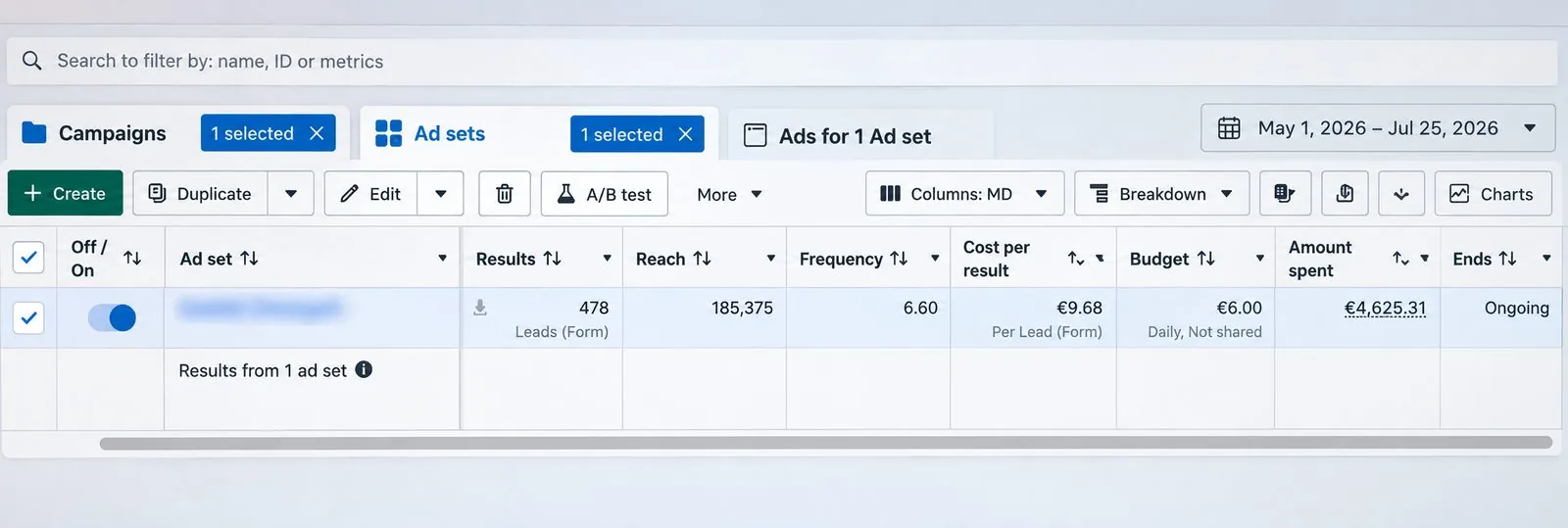
Between 1 May and 25 July 2026, one campaign produced 478 leads at €9.68 each. These were enquiries, not sales, and results vary by business. What matters for a trade is the pattern: a clear offer, a short form and a fast reply.
A trade site with a good request form is the first half of that system. If you later want more requests, Meta ads in Malta can send local people to it.
Want a website that is ready for real enquiries? Apply now for a trade website
Our way
| Step | How it is often done | How we do it |
|---|---|---|
| Start date | A wait for a free slot | Work starts as soon as the first payment is made |
| First version | Weeks before you see anything | Professional Website: first version in 2–4 weeks once your content is ready |
| Licence and insurance | Left off, or buried in the footer | A clear line on the site, with your numbers |
| Request form | A generic “contact us” box | Questions chosen for your trade, with a clear next step |
| Ownership | Code and accounts with the supplier | You own the code and hold the keys |
You work on the tools; we take care of the website side and tell you plainly what we need from you and when.
Prices
Our website packages have published starting prices. Most trades start with the Professional Website.
| Package | Price | Fits |
|---|---|---|
| Professional Website | From €990 | Up to 5 core pages, mobile design, contact form, analytics and hosting set-up |
| Business Website | From €2,490 | More services, more content and a fuller page plan |
| Growth Website | From €4,900 | A site built to support ads, with an enquiry journey and a CRM connection where needed |
| Custom system | From €7,500 | Portals, booking or internal systems with user roles, quoted after a call |
See web design in Malta for the full list, or the website cost guide for what to ask in any quote.
Want a website priced and planned for your trade? Apply now for a trade website
A few straight answers
Five things: what you do in plain words, the localities you cover, real photos of past jobs, your licence or authorisation number and insurance where they apply, and a short request form. Everything else is a bonus. Use the free planner on this page to list yours.
Electrical installation work is regulated. The Regulator for Energy and Water Services (REWS) issues Authorisation A for single-phase installations and Authorisation B for single or three-phase installations up to 300 amps per phase. Showing the number on your website helps customers check you. REWS also fines people who use an authorisation card to claim an authorisation they do not hold.
Since L.N. 166 of 2023, demolition, excavation and piling, and construction must be carried out by holders of a licence from the Building and Construction Authority. Working without a valid licence can lead to up to six months in prison, a fine of up to €50,000, or both. If you hold a licence, show its number and the activity it covers.
At Malta Digital, a Professional Website starts from €990 for up to 5 core pages, a mobile design, a contact form, analytics and hosting set-up. A Business Website starts from €2,490 and a Growth Website from €4,900. The planner on this page shows how many extra jobs pay back each price, based on your own profit per job.
Both help, but the form should do the heavy lifting. A form collects the job, the locality and how soon, so you can price it and reply with a time. Show your phone number as plain text for people who prefer to call.
No. Pages that repeat the same text with a new town name are thin and add little. Name the localities you cover on one clear areas page. Add a separate page only when you have real jobs, photos and details from that locality.
Work starts as soon as the first payment is made. A Professional Website first version is ready in 2–4 weeks once your content is ready. Bigger sites take longer, and we agree the timeline with you in writing.
Sources
Keep reading
Another trust-led site: what patients check and the rules that apply.
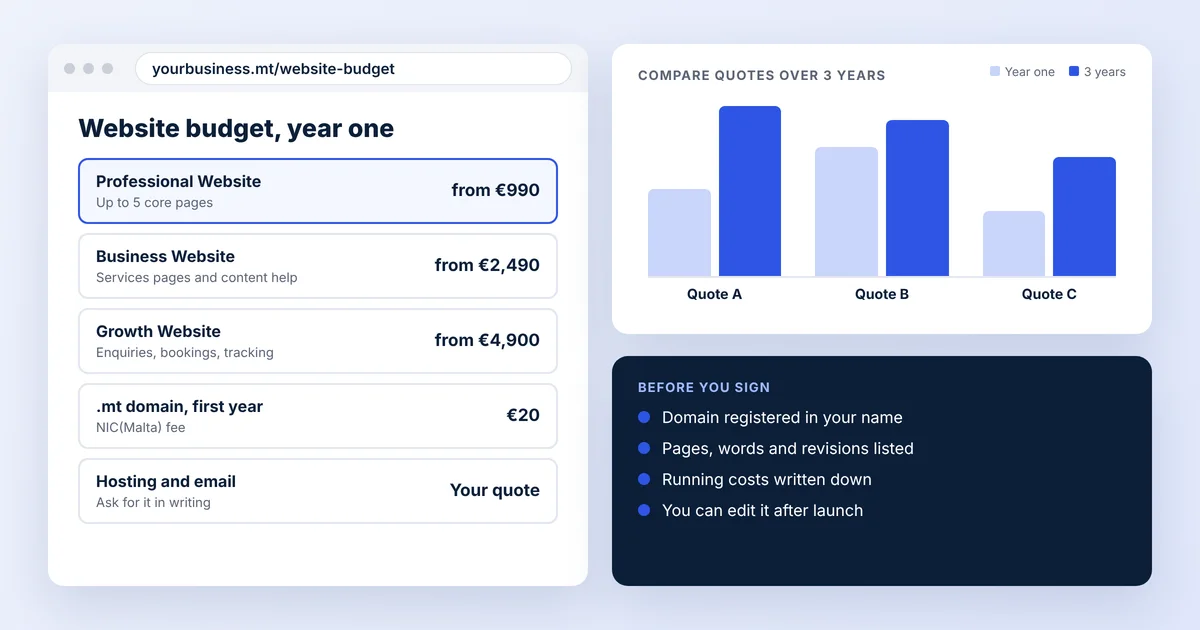
Published prices, what is included and what to ask for in a quote.
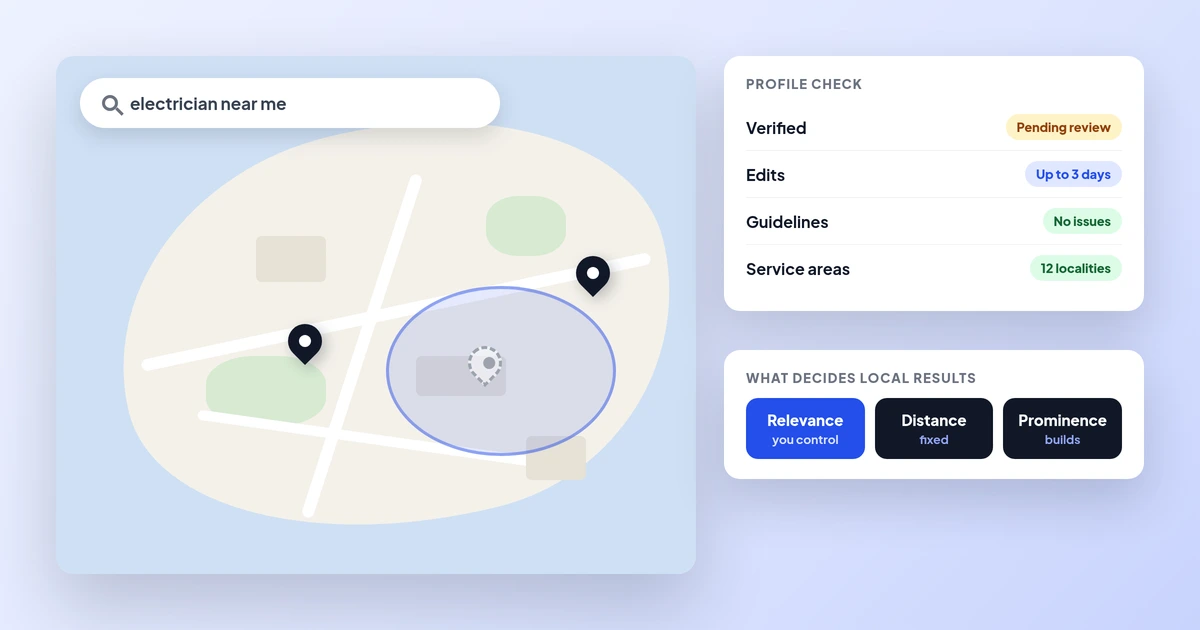
Why a Malta business is missing from the map and how to fix it.
A useful first step
Professional Website from €990, Business Website from €2,490 and Growth Website from €4,900. Tell us your trade and the localities you cover, and we reply with what we would build.
Step 1 of 2
A few quick questions, about a minute. We usually reply within 2–3 hours.