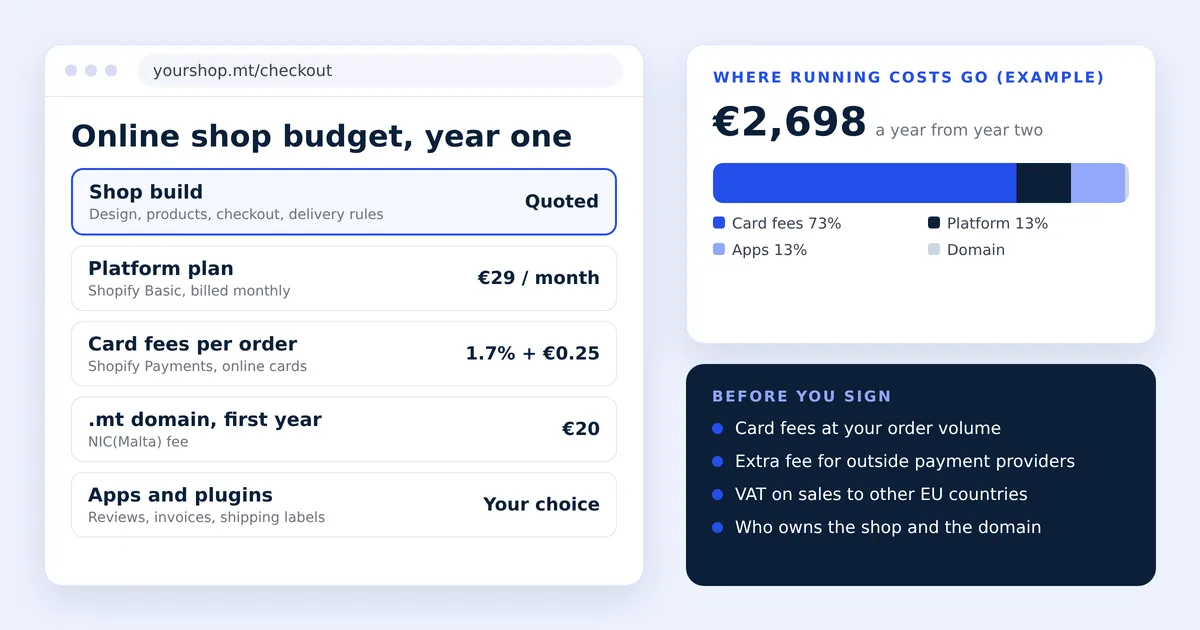
E-commerce website cost in Malta
Build prices, running costs and a worked example.
Websites · Online shops
Three questions decide your VAT: how you are registered in Malta, where your customers are and where the goods ship from. This guide covers the 2026 thresholds, the One Stop Shop, imports and what your shop must get right, with a free checker.
An online shop in Malta registers for VAT under Article 10, or under Article 11 if its domestic turnover last year did not go over €35,000. Sales to consumers in other EU countries stay under Malta rules up to €10,000 a year in total; above that, each sale is taxed at the customer’s country rate and can be declared in one quarterly One Stop Shop (OSS) return. Malta Digital builds shops with VAT set up from day one as part of web design in Malta.
The short version
VAT for an online shop in Malta comes down to three questions. How are you registered in Malta? Where are your customers? And where do the goods ship from? Get those three right and the shop settings follow. Get them wrong and you can charge the wrong rate on every order for months before anyone notices.
This guide explains each step in plain words, with the thresholds that apply in 2026 and a free checker that shows which route probably fits your shop. It is written for owners, not accountants. It is not tax advice, and every shop should confirm its set-up with an accountant before launch. If you are still choosing a platform, read ecommerce website design in Malta first; if you are pricing a shop, see the web design in Malta packages.
Step 1
Malta has two main VAT registrations for a business that sells. Under Article 10 you charge VAT on your sales, file regular returns and can claim back the VAT you pay on business costs, such as stock, packaging or your website. Under Article 11, the small undertaking scheme, you do not charge VAT, but you cannot claim any back either, and your sales are treated as exempt without credit.
From 1 January 2025 Malta rewrote these rules to follow the EU’s new small business scheme. Article 11 is open if your domestic annual turnover in the previous calendar year did not go over €35,000, the threshold the European Commission lists for Malta. Malta does not use different thresholds for different sectors. If you are on Article 10, you can only switch to Article 11 after 12 months, and companies must count a share of the turnover of related businesses they own or control by more than 10%.
Which is better for a shop? It depends on your customers and your costs. If you sell to consumers and your costs carry little VAT, Article 11 can keep prices lower. If you buy a lot of stock with VAT on it, or sell to businesses who can reclaim VAT, Article 10 often works out better. An Article 11 business that buys goods from other EU countries may also need an Article 12 registration. These are exactly the questions to put to your accountant before the shop goes live.
There is also a new cross-border small business scheme. A small business with total EU turnover of up to €100,000 can use the exemption in other EU countries as well, through a single notification in Malta. Few Malta shops need it at the start, but it is worth knowing it exists.
Step 2
The key number is €10,000. If your total sales to consumers in other EU countries, counting goods shipped from Malta plus certain digital services, stay at or below €10,000 in both the current and the previous calendar year, those sales normally stay under Malta VAT rules. Once you go over, each sale is taxed in the customer’s country, at that country’s rate, from that point on.
The threshold is for the whole EU, not per country. A Malta shop selling €4,000 to Italy, €4,000 to Germany and €3,000 to France is over it. You can also choose to charge the customer’s country rate before you reach €10,000, but the Commission says that choice binds you for two calendar years.
What does that mean for prices? A product you sell for €50 before VAT costs a Malta customer €59 at 18%, but €61 for an Italian customer at 22% and €62.50 in Sweden at 25%. Above the threshold, your checkout must work this out by the customer’s country. Many shops keep one public price and accept a slightly different margin per country instead; either way, the shop has to know where each customer is.
Want an online shop that charges the right VAT for each country? Apply now for an online shop
The One Stop Shop
Without help, going over €10,000 would mean registering for VAT in every country you sell to. The EU’s One Stop Shop (OSS) avoids that. With the Union scheme you register once, through the Malta Tax and Customs Administration portal, and file one OSS return each quarter listing your sales to each EU country and the VAT due. Malta passes the money on to the other countries.
Four rules catch people out. First, the OSS return is in addition to your normal Malta VAT return, not instead of it. Second, it is all or nothing: if you use OSS, every sale that falls under it, to every EU country, goes through it. Third, the return is due by the end of the month after each quarter. Fourth, OSS records must be kept for ten years.
The Commission’s page for Malta adds two local details. Malta does not require a tax representative to use the Union OSS, and sales declared under OSS or IOSS do not need Maltese fiscal receipts under the Thirteenth Schedule to the VAT Act. That matters for the shop build: your order emails and invoices should carry the right information, but you do not need a fiscal receipt printer for online orders declared through OSS.
Step 3
Many Malta shops sell goods that come straight from a supplier outside the EU, for example from China or the UK, to the customer’s door. These are distance sales of imported goods, and the €10,000 threshold does not apply to them.
For consignments worth up to €150, the Import One Stop Shop (IOSS) lets you charge VAT at checkout and declare it in a single monthly return, so the customer does not get a VAT bill from the courier on delivery. Businesses established in the EU, like a Malta shop, can register for IOSS themselves; sellers outside the EU must appoint an intermediary. Consignments over €150 and goods subject to excise duty, such as alcohol or tobacco, go through normal customs import instead.
If you sell on a marketplace, the marketplace can become the “deemed supplier” and handle VAT in some cases, mainly where the seller is outside the EU or the goods are imported in low-value parcels. A Malta-established shop selling its own stock on its own website is still responsible for its own VAT.
Business buyers
Everything above is about consumers. Sales to VAT-registered businesses in other EU countries follow separate rules and usually do not go through OSS. Check the buyer’s VAT number on the EU’s free VIES service before you invoice, keep a record of the check, and ask your accountant how the invoice should read and what you need to report.
For the shop, this means an optional VAT number field at checkout for business customers, a saved VIES check, and invoice templates that switch automatically. Shops that sell to both consumers and trade, such as building supplies, catering equipment or office products, should plan this from the first day rather than bolting it on later.
Free tool
Enter last year’s sales and a typical product price. The checker shows which Malta registration may fit, whether the EU €10,000 threshold applies, and what one product costs a customer in another EU country. It is a starting point for the conversation with your accountant.
Thresholds and rates as read on 10 November 2026. Not tax advice. Nothing you type is sent anywhere.
This checker needs JavaScript. The three steps above work just as well on paper.
The checker uses standard rates only and simple yearly totals. Real cases depend on what you sell, when you crossed a threshold and how you are registered.
The shop itself
| Task | Why | How it is set up |
|---|---|---|
| Prices shown with VAT | EU price rules say the price shown to consumers is the final price including VAT and other taxes | Prices entered once; the checkout adds the right rate |
| Rate by country | Needed once you pass €10,000, or opt in early | Tax rules per EU country, switched on when your accountant says so |
| Reduced rates | Some products are not at 18% | A tax class per product, agreed with your accountant |
| Customer country evidence | Shows where each sale is taxed | Billing and delivery country saved on every order |
| Business buyers | Different invoices for VAT-registered buyers | Optional VAT number field with a VIES check |
| Reports | OSS returns are quarterly, IOSS monthly | An export of sales by country and rate for your accountant |
| Records | OSS records are kept for ten years | Orders and invoices stored and backed up, not deleted with old products |
None of this needs to be expensive, but it does need to be decided before launch. A common problem is a shop that keeps charging 18% to every customer in Europe long after crossing the threshold, because nobody owned the setting. Ask whoever builds your shop to show you the tax settings and the sales-by-country report before you go live. For the other legal pages a shop needs, see website legal requirements in Malta.
What changes next
The EU’s “VAT in the Digital Age” package brings more changes from 1 January 2027, and Malta has already written them into its VAT Act. Two matter for shops. The €10,000 threshold will only count distance sales of goods shipped from the country where you are established. And registering for OSS will itself move the place of supply to the customer’s country, even below the threshold.
In practice, a Malta shop that signs up for OSS early will charge destination rates from that point. If you plan to grow into Europe in 2027, ask your accountant whether to register now or wait, and make sure the shop can switch on country rates without a rebuild.
How we build shops
We build online shops on the platform that fits your catalogue, with VAT set up the way your accountant confirms: prices with VAT for consumers, rates by country, product tax classes, invoices and a sales report by country. You own the shop and every account behind it.
| Package | Price | Fits |
|---|---|---|
| Business Website | From €2,490 | A smaller catalogue with more pages and a fuller plan |
| Growth Website | From €4,900 | A shop built to support ads, with tracking and an email or CRM connection |
| Custom system | From €7,500 | Trade portals, B2B ordering or links to stock and accounting software |
An online shop is quoted after we see your catalogue, because the number of products, variants and payment options changes the work. Work starts as soon as the first payment is made, and a first version is ready in 2–4 weeks once your content is ready. For running costs, see the ecommerce website cost guide.
A shop also needs traffic. Our e-commerce case study shows €573k in tracked sales from €95k in Meta ad spend for one online store. Results vary by business, but the shop has to charge correctly before any of that traffic arrives.
Want an online shop set up properly for VAT? Apply now for an online shop
A few straight answers
Yes, if you sell as a business you need a Malta VAT registration. Small businesses whose domestic turnover in the previous year did not go over €35,000 may use Article 11, which means no VAT is charged and none is claimed back. Others register under Article 10. Ask an accountant which fits your shop.
€10,000 a year, counted across all EU countries together for sales of goods shipped to consumers plus certain digital services. Up to that amount, Malta VAT rules normally apply. Above it, each sale is taxed at the customer’s country rate.
The One Stop Shop is an EU scheme that lets a Malta business declare VAT on sales to consumers in other EU countries in one quarterly return, filed through the Malta tax portal, instead of registering in each country. It is filed on top of your normal Malta VAT return.
The Import One Stop Shop covers goods shipped to EU consumers from outside the EU in consignments worth up to €150. It lets you charge VAT at checkout and declare it in a monthly return, so customers do not pay VAT to the courier on delivery. You only need it if you sell imported goods in that way.
Malta’s standard VAT rate is 18%. Malta also has reduced rates of 5% and 7% and a 12% parking rate for certain goods and services, according to Your Europe.
For consumers, yes. EU price indication rules say the selling price shown to consumers is the final price including VAT and all other taxes. Your shop can still show prices without VAT to logged-in business buyers.
Yes. We set up prices with VAT, rates by EU country, product tax classes, invoices and a sales report by country, following what your accountant confirms. We build the shop; your accountant handles your registration and returns.
Sources
Keep reading
Build prices, running costs and a worked example.
What works from Malta, and what you still need.
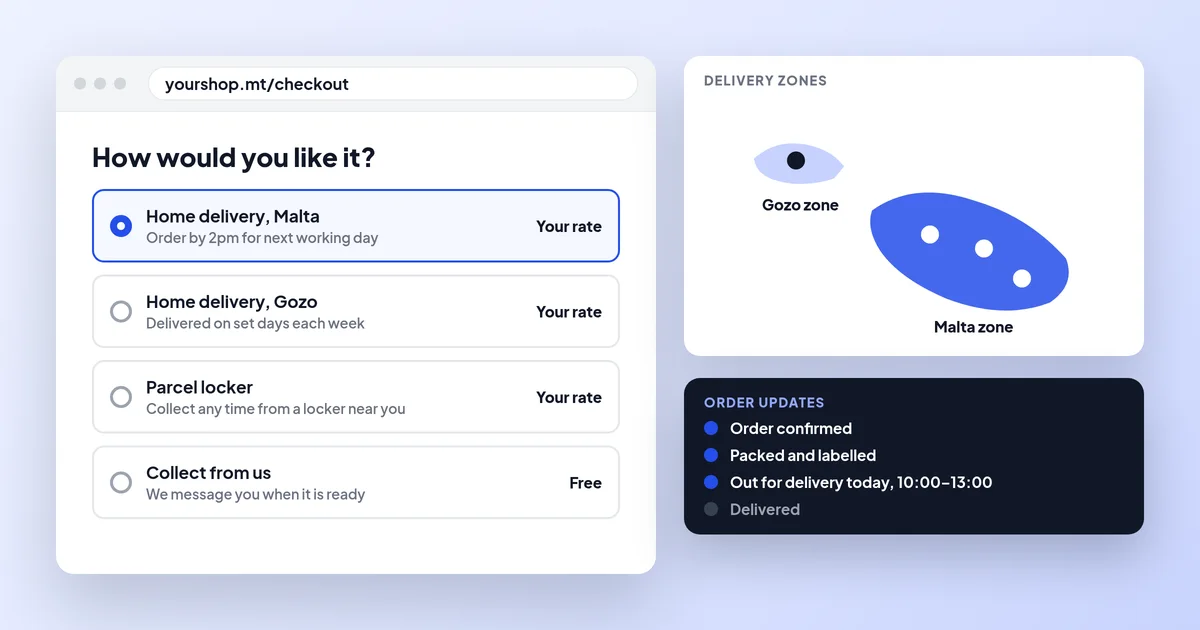
Couriers, MaltaPost and delivery to Gozo.
A useful first step
Business Website from €2,490, Growth Website from €4,900 and custom systems from €7,500. Online shops are quoted after we see your catalogue. Tell us what you sell and we reply with what we would build.
Step 1 of 2
A few quick questions, about a minute. We usually reply within 2–3 hours.