Facebook Ads for Contractors: More Quote Requests in Malta
How contractors and home service businesses in Malta get quote requests from Facebook and Instagram ads: job photos, lead forms that qualify, fast follow-up.
Facebook & Instagram ads · Solar and energy
Solar ads in Malta work when they sell a clear next step, such as a free roof survey, and follow the grant calendar closely. Malta Digital runs these campaigns for installers as part of Meta ads management in Malta, from €1,249 a month plus ad spend.
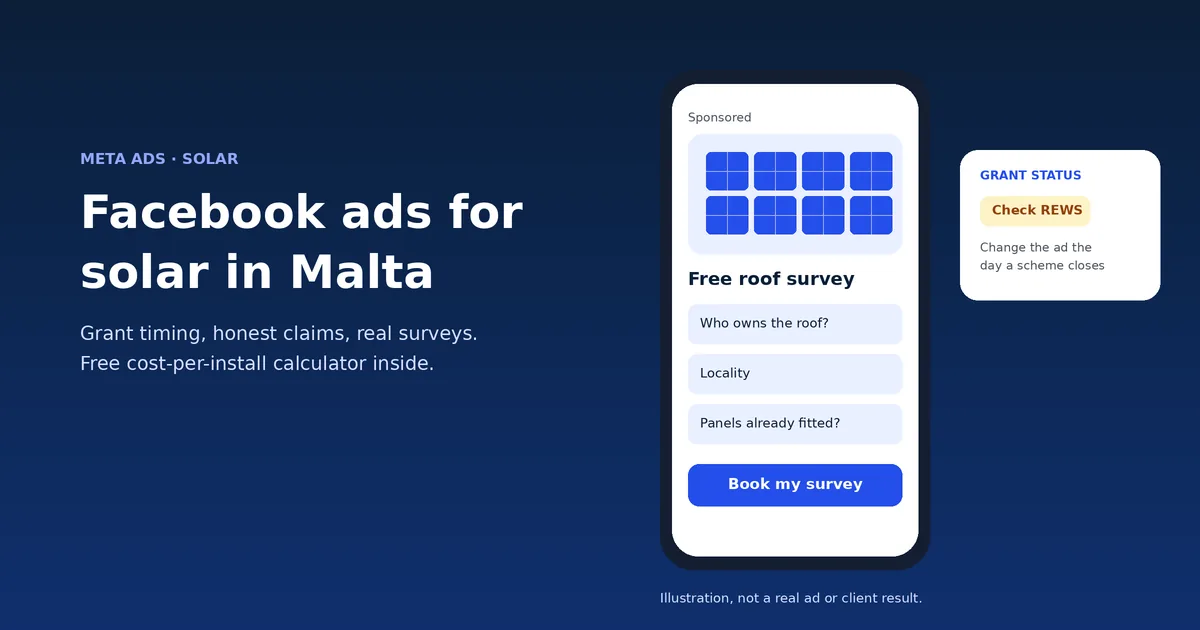
Facebook ads work for solar installers in Malta when they offer one clear step, like a free roof survey, ask qualifying questions in the form, and change the message the day a grant opens or closes. Talk about savings and installation, not energy politics, which Meta does not allow in EU ads. Malta Digital runs this as part of Meta ads management in Malta.
The short version
A solar system is a big purchase. Few people buy one from an ad. They take a small first step instead: a roof survey, a quote, or a call about batteries. Your ad has one job, which is to get that first step booked by the right people.
Malta adds two twists. The first is the grant. In 2026, interest in solar was shaped by the government’s Renewable Energy Sources (RES) scheme, run by REWS, the energy and water regulator. When it opened, demand rose. When funds ran out, it stopped. Ads that still promised a grant after that date sent people away annoyed.
The second twist is Meta’s own rules. Since October 2025 Meta does not run ads about social issues in the EU, and its EU list includes environmental politics and the economy. So an ad that argues about climate policy or electricity prices can be stopped. An ad that sells panels, batteries and savings is fine. This guide shows how to plan around both. For the full cost picture, see our Facebook ads cost guide for Malta.
The grant calendar
The 2026 RES scheme opened in April 2026 under Government Notice 597 of 2026. It was for private individuals on their homes, and for organisations that do not carry out an economic activity. For a PV system with a hybrid inverter it paid 65% of eligible costs, up to €3,000 per system and €645 per kWp. Battery storage added 75% of eligible costs, up to €6,000 per system and €600 per kWh.
Then it closed in two steps. From 13 July 2026, REWS stopped taking applications for battery-only systems and for hybrid or battery inverters with batteries. From 12 September 2026, it stopped taking applications for the whole call. Times of Malta reported 3,351 applications, with €4.1 million for PV, €11.2 million for batteries and a further €5 million added later in the year.
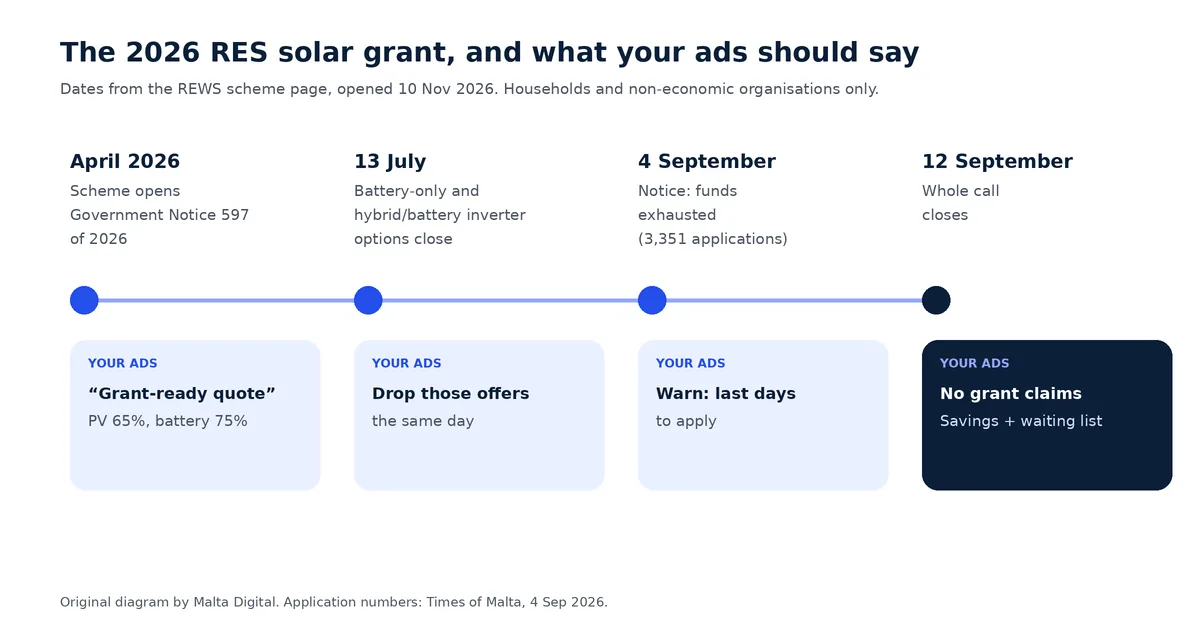
Two rules matter for your ads. Part A of the application must go to REWS before the equipment is bought and installed, and it needs a quotation. So when a scheme is open, “get your grant-ready quote” is an honest and useful offer. And the installation must be finished, with Part B sent, within eight months. That gives you a natural reason to follow up every lead.
Today, in November 2026, the 2026 call is closed. No 2027 call was listed on the REWS schemes page when we checked it on 10 November 2026. So ads should not mention a grant at all, or should only say “we will tell you if a new scheme opens”. Check the REWS page before every campaign.
What to say
Meta’s help page on social issues says plainly that social issue, electoral and political ads are not allowed in the European Union. Its EU list includes environmental politics and the economy. Ads that take a stand on those topics, or try to sway opinion about them, can be rejected.
For a solar installer the line is simple. Sell the product and the service. “Cut your electricity bill with panels on your roof” is a product ad. “The government must act on climate change” is advocacy. So is an ad that attacks energy tariffs or a political decision. Keep those for your own posts, not paid ads.
| Ad message | OK for a paid ad? | Why |
|---|---|---|
| “Book a free roof survey in Mosta” | Yes | Sells a service |
| “Add a battery to the panels you already have” | Yes | Sells a product |
| “Grant-ready quotes while the scheme is open” | Yes, only while it is open | True and checkable on the REWS page |
| “Save exactly €600 a year” | Risky | Needs proof; use an example from the survey |
| “The government must do more on climate” | No | Environmental politics: a social issue ad |
| “Electricity prices are a scandal” | No | Economy debate: a social issue ad |
Savings claims need care too. Do not promise a fixed bill or a payback time you cannot prove. Use the customer’s own numbers in the survey, and show an example clearly marked as an example. If an ad is rejected, our guide to a rejected Facebook ad shows how to appeal.
Apply now. We will look at your offer, your form and the grant calendar, and tell you what to change first.
The offer
Homeowners respond to one clear next step. A free roof survey works well, because people want to know if their roof is suitable before they talk price. A free battery check suits homes that already have panels. For flats, a short “is my roof share suitable?” call can work, since many homes in Malta are flats with a shared roof.
Use a lead form with two or three multiple-choice questions. Ask who owns the roof, which locality the property is in, whether panels are already fitted, and when they want the work done. These answers let your team call the best leads first. Meta’s Higher intent form type adds a review screen before people submit, which cuts careless taps. See how to stop fake Facebook leads for more filters.
For bigger jobs, such as a full PV and battery system, a short landing page with real installs, warranties and a clear process can bring fewer but better enquiries. Test both. Our guide on a lead form or landing page shows how to compare them on cost per customer.
Free tool
A cheap lead is not a cheap installation. Enter your monthly ad budget, your cost per lead, how many leads book a survey, how many surveys sign, and the gross profit on one job. The calculator shows what one installation costs you in ads and what is left after ad spend. The starting numbers are examples only. Nothing leaves this page.
Example numbers, not results. Replace them with yours.
This tool needs JavaScript. The maths: leads = budget ÷ cost per lead; installs = leads × survey rate × sign rate; cost per install = budget ÷ installs.
Creative
Show real roofs in Malta and Gozo. A short vertical video of your team fitting panels on a flat roof, with the locality named, beats any stock photo. A before-and-after photo of a roof, or a clear diagram of the system with the battery, also works well.
Write the first line for one person. “Own a house in the north with a flat roof?” speaks to a real buyer. Add one fact that builds trust, such as how long you have installed in Malta, your warranty, or how quickly you can survey. End with the step: “Book a free roof survey”.
Refresh ads every few weeks. Malta is small, so the same people see your ads often. A new photo or a new first line keeps costs steady. Our Facebook ad creative guide has more ideas.
How we run it
We start with the calendar. When a grant is open, the ads offer a grant-ready quote and we watch the REWS page every week. The day an option closes, we change the ads. When no scheme is open, we switch to savings, batteries for existing panels, and a waiting list for the next call, without promising one.
Next comes tracking. Every lead goes to your inbox or CRM with its answers, and we count surveys booked and contracts signed, not just leads. That is how we know which ad brings installs, not only form fills. We also set up the Meta pixel and Conversions API on your site.
Finally, we keep the ads inside Meta’s rules. No climate politics, no claims you cannot back up, and no grant promises after funds run out. That keeps the account healthy, which matters when you need to spend fast the day a new scheme opens.
Proof
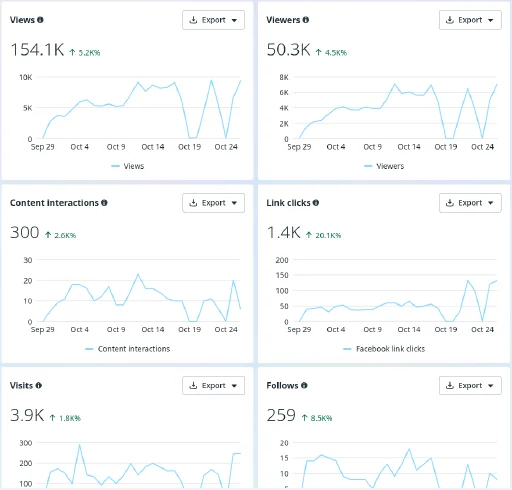
The closest result we can show is a furniture installation business, which sells big home jobs like kitchens and wardrobes. In its first 28 days with us, €346.75 of ad spend brought 395 WhatsApp taps and 10 phone calls. Its Facebook views went from 858 to 154.1K. A solar installer sells a bigger job, but the same idea applies: show real work, make the first step easy, and reply fast.
A few straight answers
Yes, when the ad offers one clear step like a free roof survey, the form asks qualifying questions, and the message follows the grant calendar.
Only while a scheme is open. The 2026 RES call closed on 12 September 2026. Check the REWS page before any ad mentions a grant.
Often because it reads as a social issue ad. Meta does not allow ads on environmental politics or the economy in the EU. Sell the product, not a cause.
Who owns the roof, the locality, whether panels are already fitted, and when they want the work done. Two or three multiple-choice questions are enough.
A lead form brings more enquiries; a landing page often brings better ones for large systems. Test both and compare cost per signed contract.
The 2026 call was for private individuals on their homes and for organisations that do not carry out an economic activity. Businesses should not be told it applies to them.
You set the ad budget and pay Meta directly. Our management starts from €1,249 a month plus ad spend. Use the calculator above to see what one installation costs.
Sources
Keep reading
How contractors and home service businesses in Malta get quote requests from Facebook and Instagram ads: job photos, lead forms that qualify, fast follow-up.
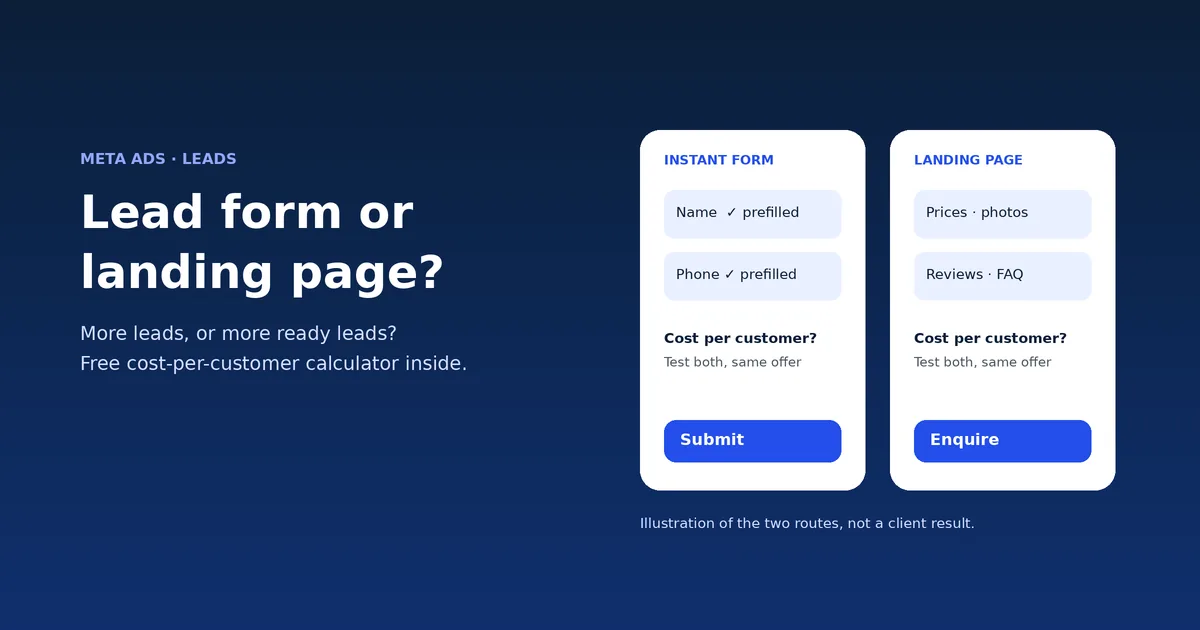
Facebook lead form or landing page? What each is good at, how lead quality differs, which Malta businesses should use which, and a free calculator.
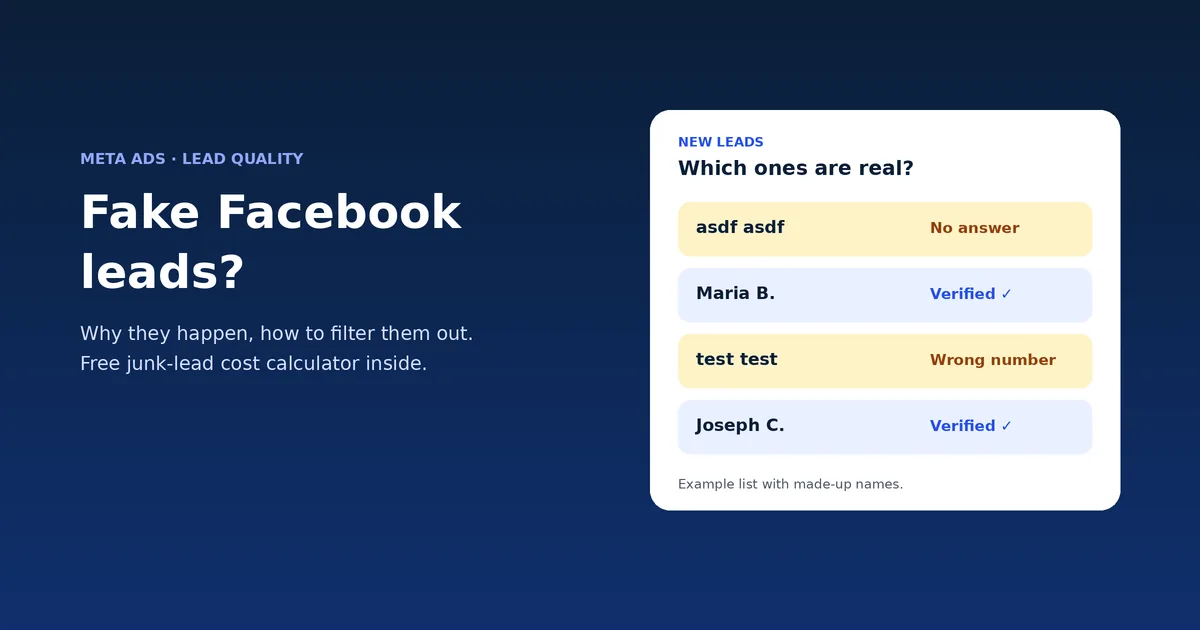
Getting fake or junk Facebook leads? Why it happens, the Meta settings that filter them out, including SMS verification, and a free junk-lead cost calculator.
A useful first step
We plan around the grant calendar, keep your ads inside Meta’s rules, and count surveys and signed jobs. Meta ads management from €1,249 a month plus ad spend, with the ad account in your name.
Step 1 of 2
A few quick questions, about a minute. We usually reply within 2–3 hours.