
Facebook Ads Targeting: Audiences and Strategy for Malta
How Facebook and Instagram ads targeting works in 2026: location, age, interests, custom and lookalike audiences, and what works on a small market like Malta.
Facebook & Instagram ads · EU rules
Malta Digital runs Facebook and Instagram ads for businesses across Malta and Gozo, as a Meta ads agency in Malta. Since 2024, people in the EU, Malta included, can choose ads that use far less of their data. This guide explains what changed, what it does to results, the setting that can block your own ads and what to do. For budgets, see Facebook ads cost in Malta.
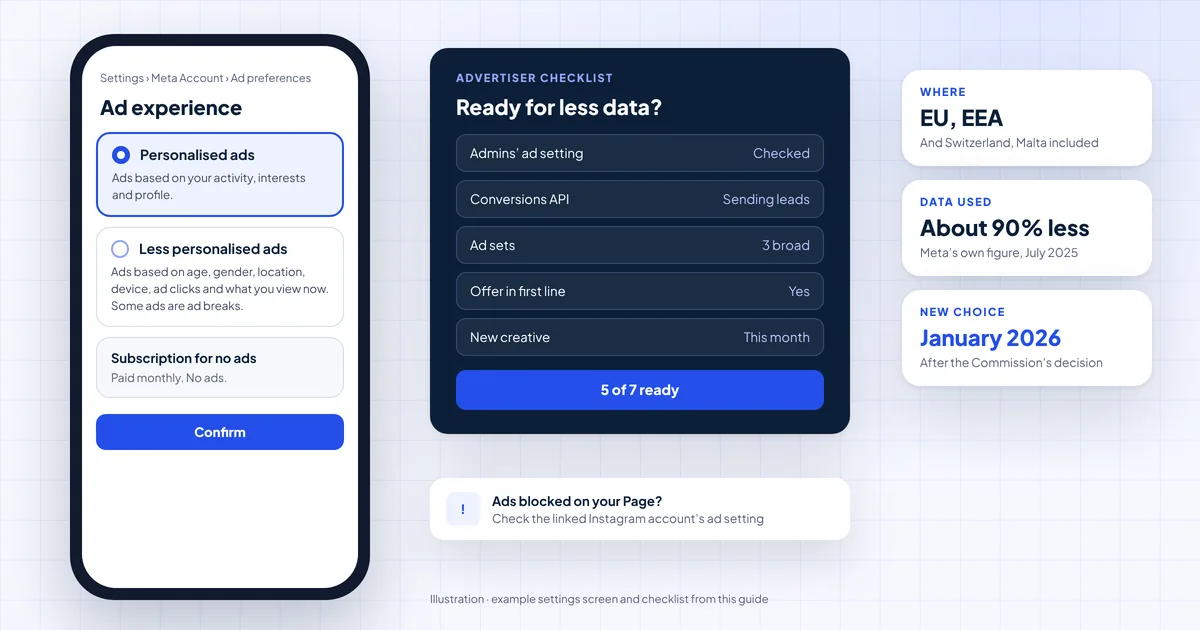
People in the EU who use Facebook and Instagram free can choose less personalised ads. Meta then uses only their age, gender, location, device, ad clicks and what they view in that session. Meta says these ads bring far fewer conversions, so strong creative, clean tracking and your own customer data matter more. Malta Digital builds campaigns that way.
What changed
Until late 2023, everyone on Facebook and Instagram saw personalised ads. EU rules changed that. Today a person in Malta can pick one of three options.
Free. Meta uses their activity, interests and profile to choose ads.
Free. Meta uses a small set of data. Some ads are ad breaks that cannot be skipped for a few seconds.
Paid. No ads, and their data is not used for ads.
Meta cut the subscription price by 40% in November 2024, to €5.99 a month on the web or €7.99 on iOS and Android. On the same day it launched less personalised ads.
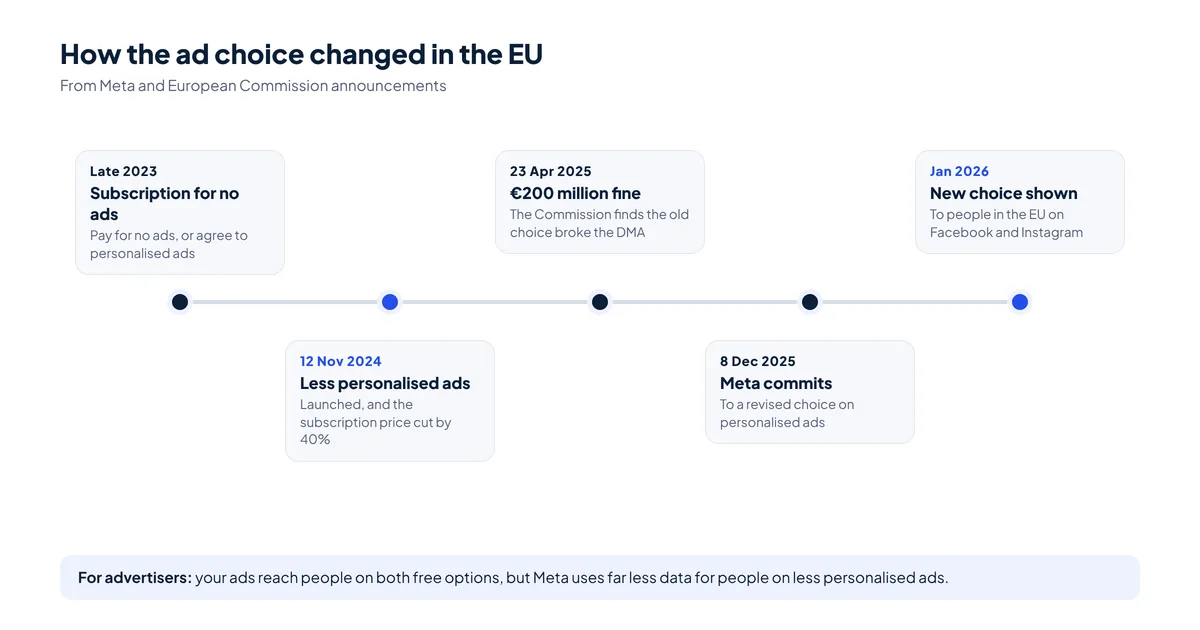
The European Commission fined Meta €200 million in April 2025 under the Digital Markets Act. It said the old choice, pay or agree to full tracking, broke the rules. In December 2025 Meta agreed to a revised choice, shown to people in the EU from January 2026. Meta is appealing the fine.
The data
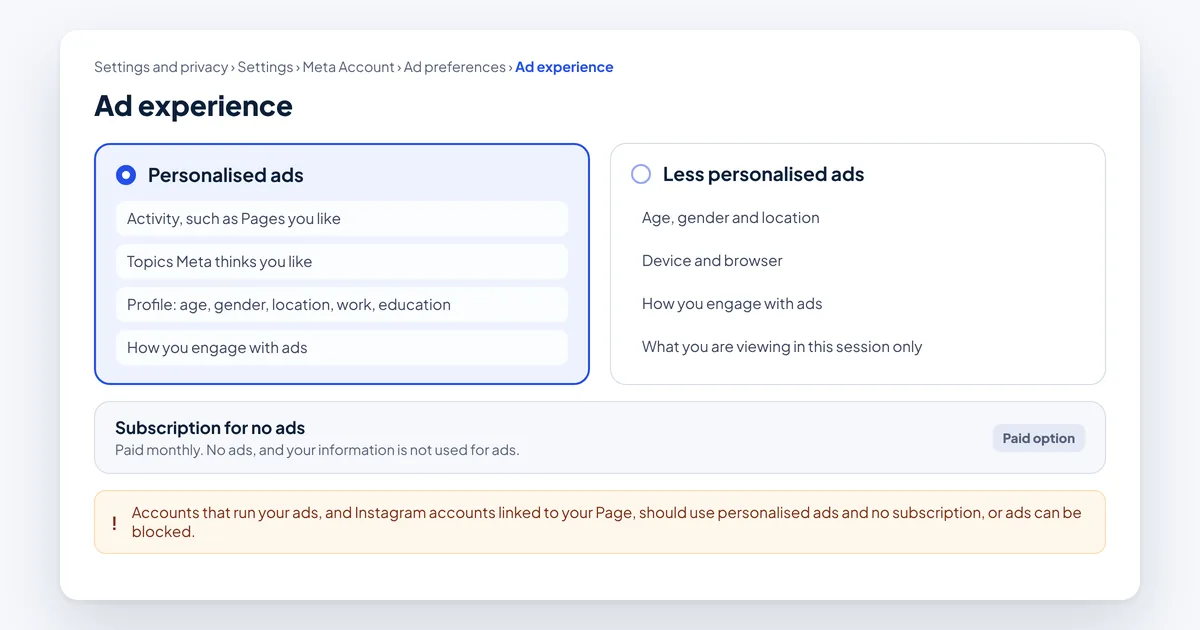
Meta’s help pages list what it uses when someone picks less personalised ads. It is a short list.
Meta gives an example. Someone scrolls in the morning and sees ads based on what is on screen then. In the afternoon, the ads change with the new content. The morning visit is not remembered for ads.
What this means for you: you do not pick who is on which option. Your ads still reach both groups. For people on less personalised ads, Meta matches your ad to what they are looking at, not to their history.
The impact
Meta has published its own early figures. In July 2025 it said less personalised ads use almost 90% less data than personalised ads.
Meta said less personalised ads brought 70% fewer onsite conversions and 61% fewer offsite conversions than personalised ads. An onsite conversion happens inside Facebook or Instagram, such as an instant form. An offsite conversion happens on your website, such as a purchase.
Treat these as Meta’s numbers. Meta published them while arguing against the decision, and the data behind them is not public. Nobody has published how many people chose each option. The Commission says it will gather evidence on uptake and impact.
Apply now and tell us what you sell and what you spend. We’ll check your tracking, settings and creative against the less-data checklist.
The hidden block
This one catches small businesses out. Meta says that choosing the subscription or less personalised ads limits your own ability to run ads, join partnership ads and earn money on Meta.
It goes further. Meta lists a problem when you run ads for a Facebook Page that is linked to an Instagram, WhatsApp or Threads account that chose the subscription or less personalised ads. So if the person who set up your business Instagram picked one of these, your ads can be blocked.
If ads are still blocked after that, see our guides to an ad account restriction and rejected ads.
Free tool
Answer seven quick questions about your account. The check shows how ready your ads are for people who chose less personalised ads, and what to fix first. Nothing you enter leaves this page.
Pick yes or no for each line. Not sure counts as no.
Your result appears here as you choose.
What to do
Less data means Meta knows less about some of the people who see your ad. The fixes all point the same way: give Meta clearer signals and give people clearer reasons.
| Old habit | What works now | Why |
|---|---|---|
| Many small, narrow ad sets | A few broad ad sets | Less data makes narrow audiences unreliable |
| Relying on retargeting | Strong first ads for new people | Past visits are not used for less personalised ads |
| Pixel only | Pixel plus Conversions API | Meta learns from more real sales and leads |
| Clever, vague headlines | The offer and price in the first line | Context ads must win attention on their own |
| Judging by Meta’s numbers only | Shop or CRM numbers side by side | Some results are modelled or missed |
| Interest lists from 2019 | Your own customer lists and lead forms | First-party data does not depend on Meta’s choice screen |
| One ad for months | New creative every few weeks | Ad breaks and repeats make people close ads |
Tracking matters most. Send each purchase or lead through the Conversions API as well as the pixel, so Meta learns from what really happened. Our guide to the Meta pixel and Conversions API shows the setup.
Then judge results on your own numbers. Compare Meta’s figures with your shop orders or your CRM, as our guide to Facebook ads attribution explains. For targeting choices, see Facebook ads targeting in Malta.
Worked example
Say a shop in Birkirkara gets 100 online orders a month from Meta ads. Nobody knows how many of its buyers picked less personalised ads, so the owner tries a guess: 1 in 10.
If Meta’s 61% drop in offsite conversions held for those 10 buyers, about 6 orders a month would go. At €60 an order, that is about €360 in sales. The checker above shows where to win it back.
The answer is rarely more budget. It is better creative for the people Meta knows less about, and clean tracking for the rest.
How we run it
Malta Digital manages Meta ads in Malta on Facebook and Instagram from €1,249 a month plus ad spend, paid to Meta in your own ad account. Tracking, ad copy, creative and reporting are included.
Proof
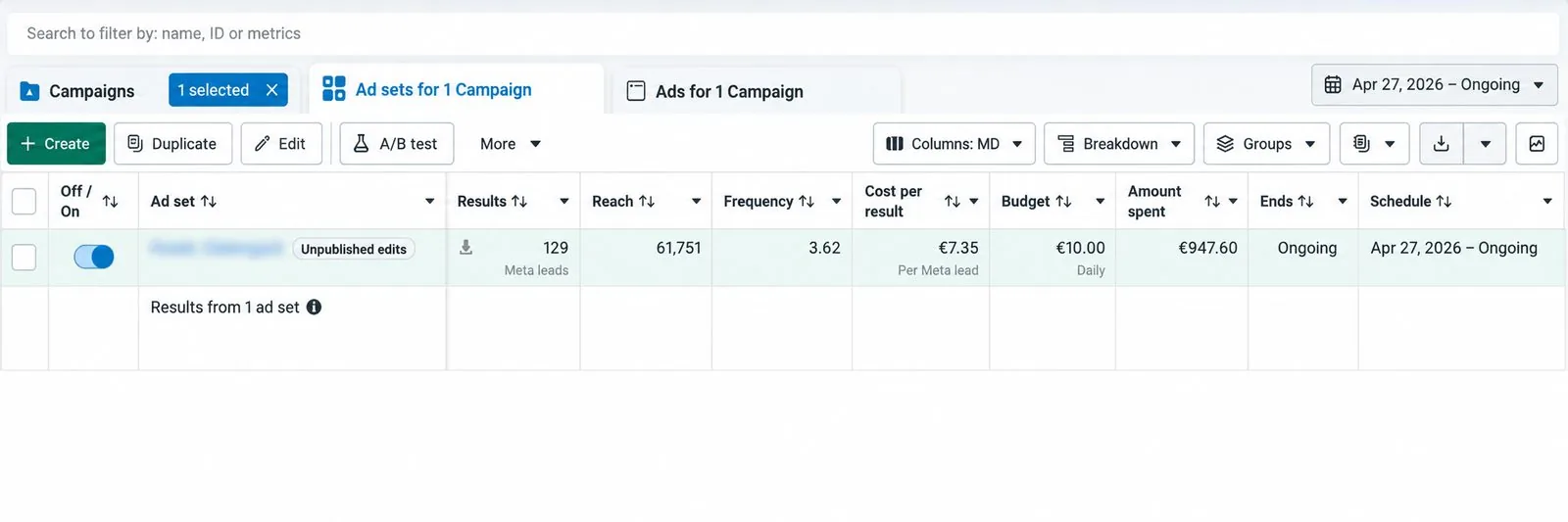
For a lead campaign we manage, Ads Manager shows 129 leads at €7.35 each, on €10 a day. A clear offer and a short form did the work, not narrow targeting. That is the approach that holds up when Meta has less data on some people.
A few straight answers
A free option in the EU. Meta shows ads using only age, gender, location, device, ad clicks and what the person is viewing in that session, instead of their full activity.
Yes. The option is offered across the EU, the EEA and Switzerland, and Malta is in the EU.
No. There is no setting for that in Ads Manager. Your ads reach both groups, and Meta uses less data for people on less personalised ads.
For people on personalised ads, yes. Meta says less personalised ads are not based on earlier sessions, and website visits are not on its list of data it uses for them, so retargeting reaches fewer people.
One reason in the EU: an admin, or an Instagram account linked to the Page, chose the subscription for no ads or less personalised ads. Meta says that limits running ads. Switch it back in Ad preferences, then try again.
Meta set it at €5.99 a month on the web and €7.99 on iOS and Android in November 2024, with extra charges for more accounts.
No. Malta Digital includes tracking, creative and reporting in Meta ads management, from €1,249 a month plus ad spend paid to Meta.
Sources
Keep reading
How Facebook and Instagram ads targeting works in 2026: location, age, interests, custom and lookalike audiences, and what works on a small market like Malta.
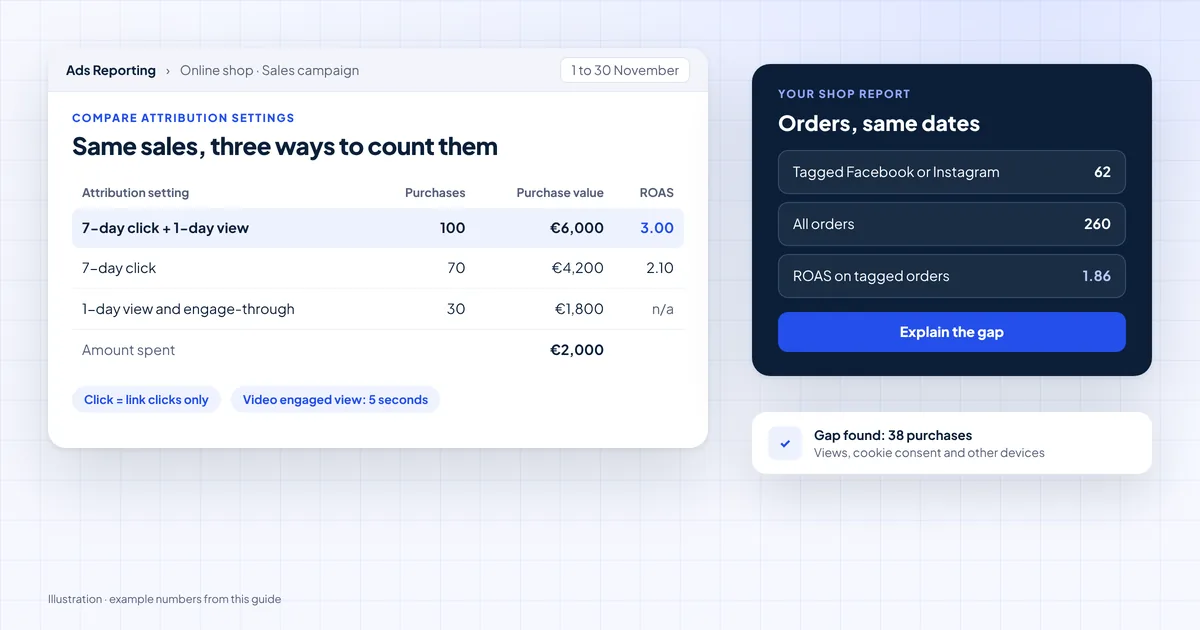
How Meta ads attribution works after the 2026 changes: click, view and engage-through windows, why Ads Manager and your shop disagree, and a free gap checker.

Meta Pixel vs Conversions API: what each does, the difference, why you need both, and how to set them up on Shopify, WordPress or a custom site and test them.
A useful first step
Tell us what you sell and what you spend. We’ll check your settings, tracking and creative and reply with the first fixes we’d make.
Step 1 of 2
A few quick questions, about a minute. We usually reply within 2–3 hours.