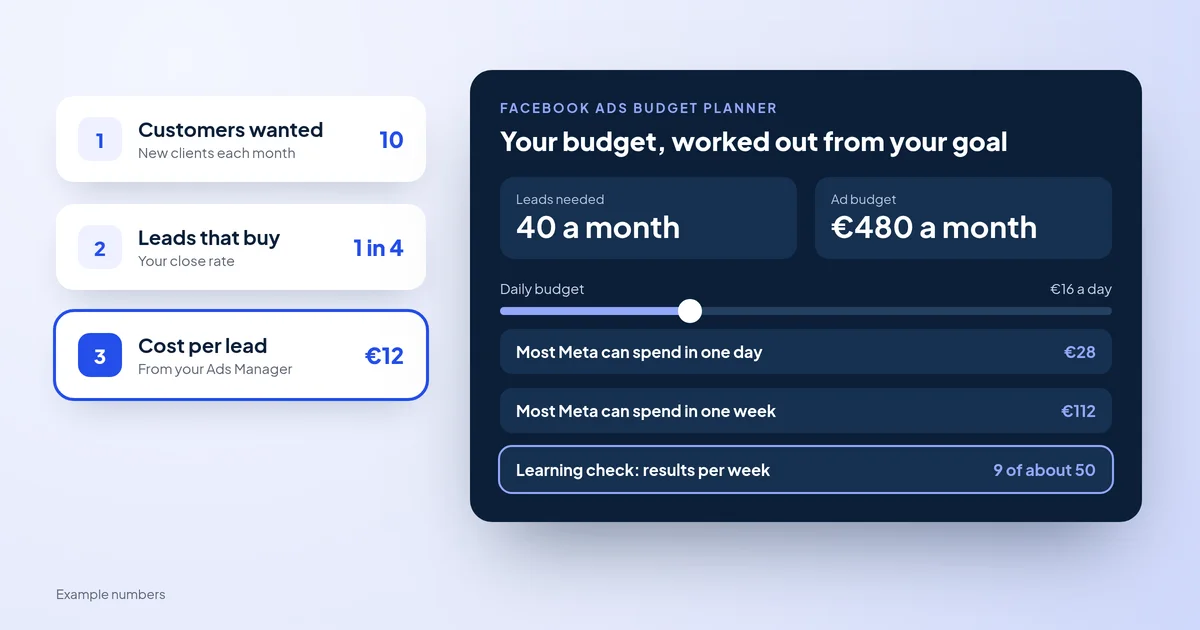
How much to spend on Facebook ads
Set your budget from your goal, check it against Meta’s learning phase, and test it in a free budget planner.
Facebook & Instagram ads · Cost per lead
Cost per lead is your ad spend divided by the leads it brought. A lead campaign run by Malta Digital brought 478 form leads at €9.68 each, but a good cost per lead for you depends on what a customer is worth, so the free calculator below works it out from your numbers.
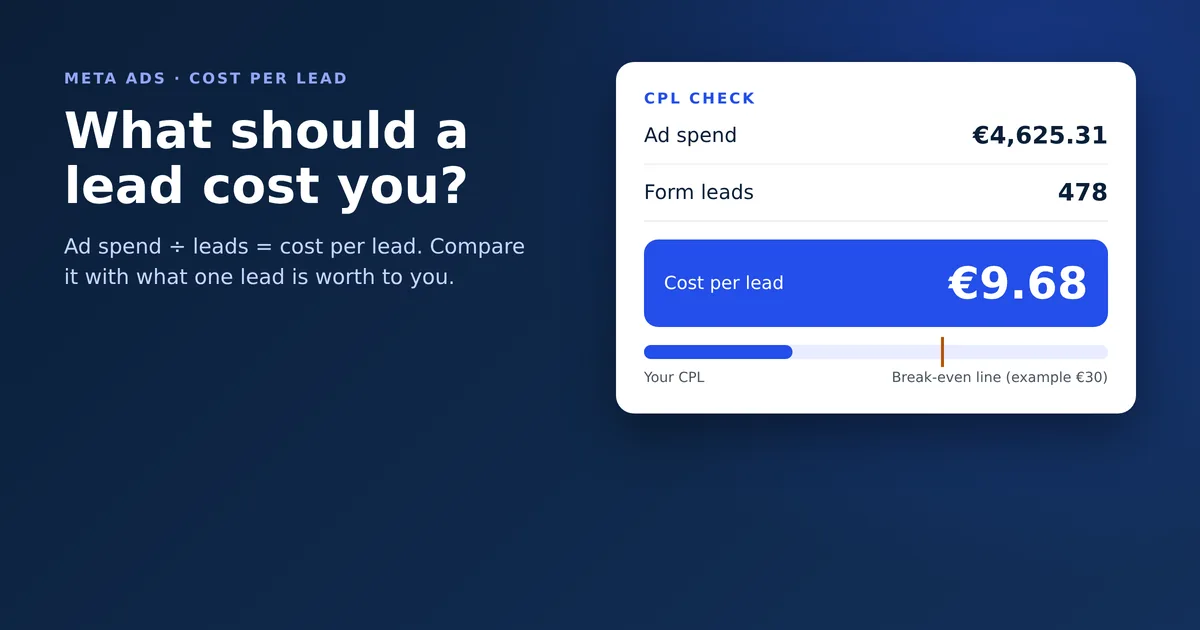
Cost per lead (CPL) = ad spend ÷ leads. A real Malta Digital campaign paid €9.68 per form lead from May to July 2026. Your safe CPL is gross profit per customer × the share of leads that buy. Below that line, the ads make money. We track this for every client in our Meta ads management.
The short answer
Cost per lead, or CPL, is what you pay Meta for one lead. A lead is a person who asks you for something: they fill in a form, send a message or call. The sum is simple. Take what you spent and divide it by the leads it brought.
In Ads Manager you will not see the words “cost per lead” on every campaign. You will see Cost per result. Ads Manager is Meta’s tool for running ads. A “result” is whatever the campaign is set to get, so on a lead campaign it means a lead.
CPL is only half the story. A €5 lead that never answers the phone costs more than a €20 lead who books. So this guide shows you how to find your CPL, how to judge it, and how to bring it down without getting worse leads. If you also want the full monthly bill, read Facebook ads cost in Malta.
CPL calculator
Type numbers from your own Ads Manager if you have run ads before. If you have not, use a careful guess and come back after two or three weeks. The calculator gives you your CPL now, your break-even CPL, your cost per booking and the budget for the leads you want. Add a fee quote to see the all-in cost.
Six answers from your own numbers: cost per lead, cost per booking, the most you can pay, a 30% stress test, the budget for your goal and the all-in cost with a fee. Everything stays on your device.
1. Your ads now
2. What a lead is worth to you
3. Leads you want
This calculator needs JavaScript. The formulas are written out under it, so you can do the same maths by hand.
Here are the formulas, so you can check them by hand. CPL = ad spend ÷ leads. Break-even CPL = gross profit per customer × close rate. Close rate is the share of leads that become customers. Monthly budget = leads you want × CPL. Leads per week = monthly budget ÷ 30.4 × 7 ÷ CPL. Cost per booking = CPL ÷ booking rate. All-in CPL = (ad budget + fee) ÷ leads.
Real example
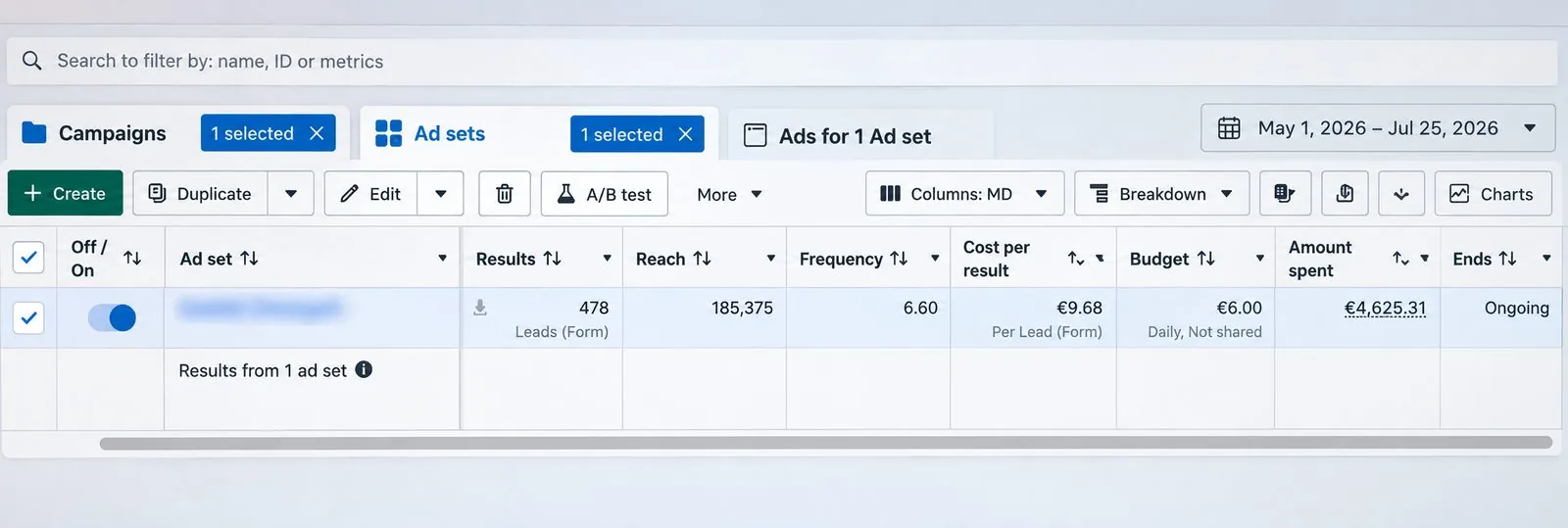
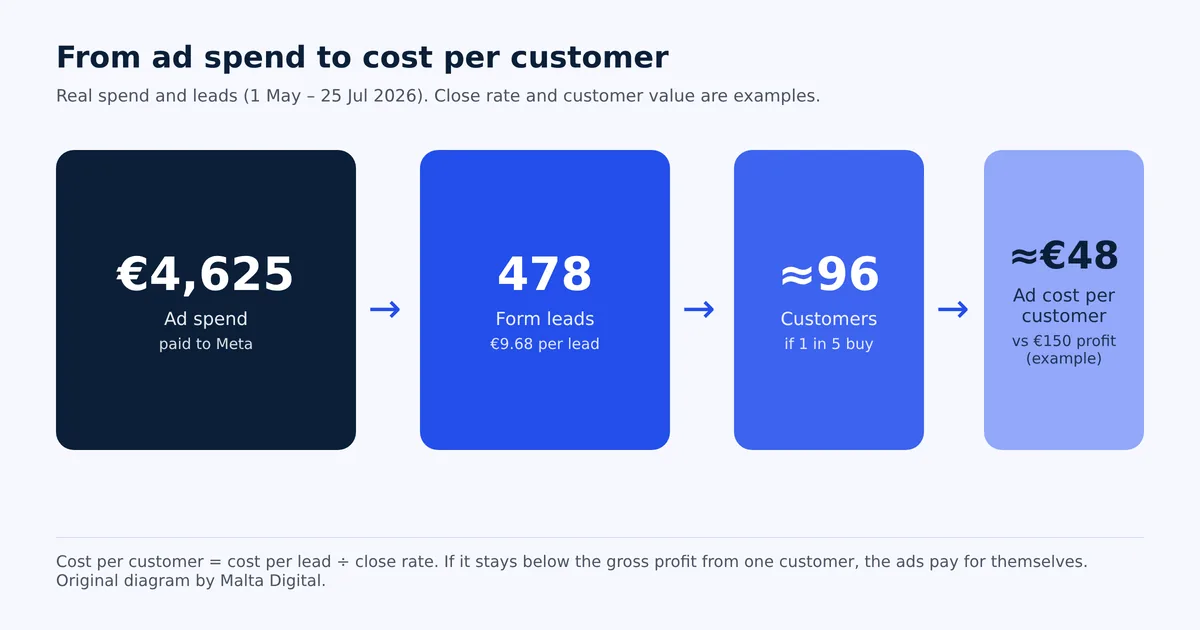
Here is a lead campaign run by Malta Digital on Facebook and Instagram. From 1 May to 25 July 2026 it spent €4,625.31. It brought 478 form leads. €4,625.31 ÷ 478 = €9.68 per lead. It ran on a €6.00 daily ad set budget, which shows a small daily budget can work when the offer and the form are right.
Now let us judge that number, as an example only. Say a business makes €150 gross profit on each new customer. Say 1 in 5 leads buys, so the close rate is 20%. One lead is then worth €150 × 20% = €30. At €9.68 per lead, each customer costs about €48 in ads (€9.68 × 5). That leaves about €102 of gross profit per customer, before any other costs.
Change one number and the answer changes. If only 1 in 20 leads bought, each customer would cost about €194 in ads, and the same €9.68 would lose money. This is why we never call a CPL “good” or “bad” on its own.
Want your cost per lead judged against what your customers are worth? Apply now for Meta ads management
Two real campaigns
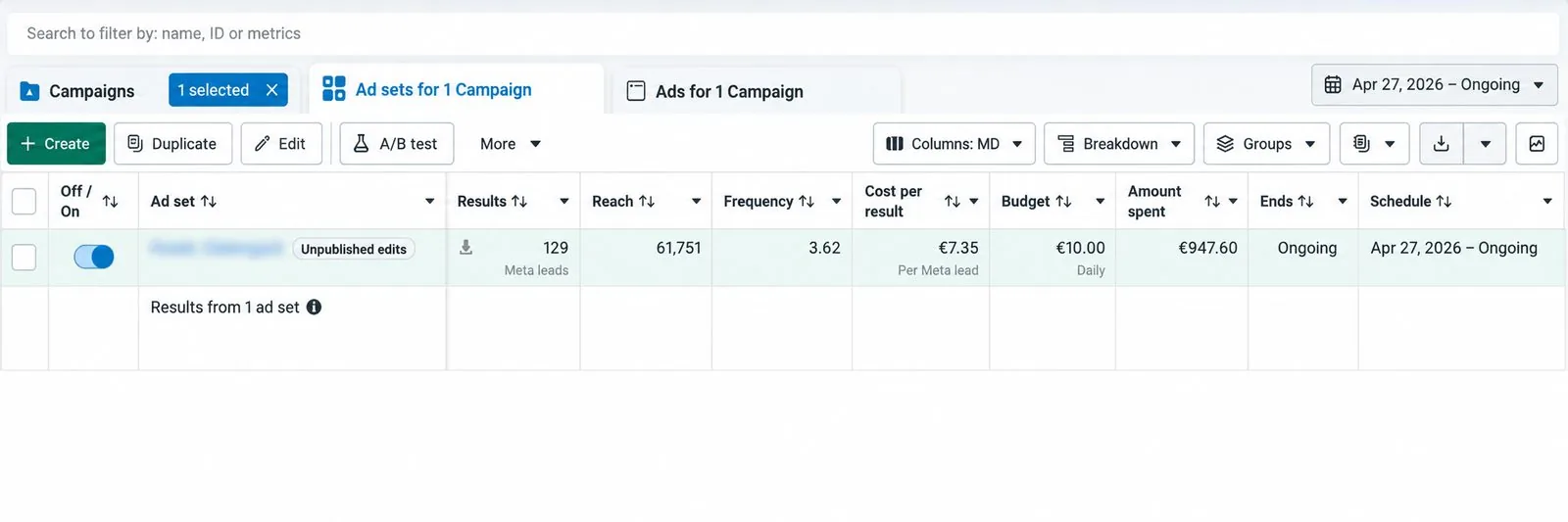
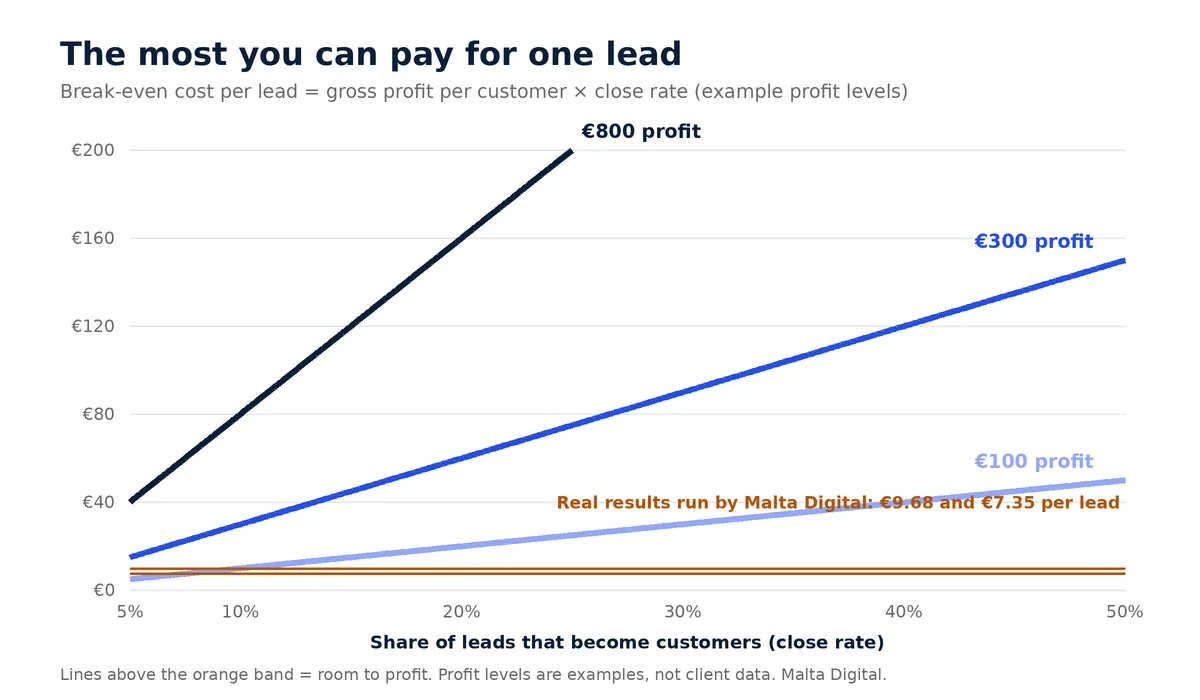
One number never tells the whole story. So here is a second lead campaign run by Malta Digital. It ran on €10 a day and brought 129 leads at €7.35 each. The first one ran on €6.00 a day and brought 478 leads at €9.68 each.
The cheaper lead is not automatically the better campaign. Each one had a different offer, form and audience. What matters is how many of those leads booked and bought. That is why the calculator now asks for your booking rate too.
The chart below shows the most you can pay for one lead. Pick your profit line and your close rate. Both real costs per lead sit in the orange band near the bottom. For most profit levels and close rates there is room above them.
Want to know which of your leads are really cheap? Apply now for Meta ads management
The table
The table below turns cost per lead into cost per customer. It is plain maths, not a benchmark: cost per customer = CPL ÷ close rate. Find your CPL on the left and your close rate along the top.
| Cost per lead | 1 in 20 buy (5%) | 1 in 10 buy (10%) | 1 in 5 buy (20%) | 1 in 2 buy (50%) |
|---|---|---|---|---|
| €5 | €100 | €50 | €25 | €10 |
| €9.68 (our example) | €194 | €97 | €48 | €19 |
| €15 | €300 | €150 | €75 | €30 |
| €25 | €500 | €250 | €125 | €50 |
| €40 | €800 | €400 | €200 | €80 |
Read it like this. A clinic that closes 1 in 2 leads can pay €40 a lead and still win a patient for €80 in ads. A shop that closes 1 in 20 needs leads near €5 to get the same result. Neither number is right or wrong. It depends on what a customer leaves you.
What moves it
Your offer. This matters most. “Free 15-minute check” or “price list in 2 minutes” gets more leads than “contact us”. A clear offer makes people stop and act, so Meta can find them more cheaply.
Your form. Meta’s instant forms open inside Facebook and Instagram. A short form gets more leads, but more of them are weak. Adding one or two questions, such as the service and the area, gets fewer leads that are more likely to buy. For a builder in Mosta, asking “Which town is the job in?” filters out people far away in Gozo before you pay a visit.
Market size. Malta is small. A narrow audience, such as one age group in Sliema and St Julian’s, runs out quickly. The same people then see your ad again and again. Frequency is how many times one person saw your ad on average. When it climbs, cost per lead usually climbs too, so change the ad before it wears out.
Season. Malta has busy months for tourism and for local spending, such as summer and the weeks before Christmas. More businesses advertise then, so the cost to reach people can rise. Plan the budget with that in mind, and compare the same months year on year.
Learning. A new ad set goes through a learning phase. Meta says it usually needs about 50 results in the week after the last big change to settle (Meta Business Help: About the learning phase). Costs swing more while it learns. Big edits restart it, so do not change everything every few days.
Apply now and share your spend, leads and close rate. We’ll tell you honestly what your break-even CPL is and what we would change first.
Worked examples
These three businesses are made up. The maths is real, so you can copy it. Each one pays Malta Digital’s starting fee of €1,249 a month plus ad spend. That shows the true cost, not just what Meta charges.
| Business | Profit per customer · close rate | Break-even CPL | Meta CPL | Booking rate → cost per booking | All-in CPL (ads + fee ÷ leads) | All-in cost per customer |
|---|---|---|---|---|---|---|
| Clinic in Sliema (example) | €300 · 30% | €90 | €15 | 60% → €25 | €1,500 + €1,249 ÷ 100 = €27.49 | €92 · profit left €208 |
| Builder in Mosta (example) | €800 · 10% | €80 | €25 | 40% → €62.50 | €1,000 + €1,249 ÷ 40 = €56.23 | €562 · profit left €238 |
| Dive school in Gozo (example) | €100 · 20% | €20 | €9.68 | 50% → €19.36 | €581 + €1,249 ÷ 60 = €30.50 | €153 · loses €53 |
The clinic and the builder both make money, even with the fee. The dive school does not. Its leads are cheap, but a €100 customer cannot carry a monthly fee at 60 leads.
So what should the dive school do? It can raise the value of a sale, for example with a two-dive package. It can get more leads from the same fee. Or it can run simple ads itself for now. We would rather say that before you apply than after.
Want these sums done with your real numbers? Apply now for Meta ads management
Benchmarks
You will find tables online that list an average cost per lead for every industry. Most do not say where the numbers come from. Many are built from US or large European accounts. Malta has no official source that publishes cost per lead by industry, and Meta does not publish one either.
That is why we only quote numbers from campaigns run by Malta Digital, with a screenshot and dates. €9.68 is a real result for one campaign. It is not a promise for yours. A lawyer, a gym and a dive school in Gozo can all run good campaigns at very different CPLs.
A better question is: “What can I afford to pay for a lead?” The calculator answers that from your gross profit and close rate. Then track a second number, cost per booking. A booking is a lead that turned into a real appointment or order. It shows if cheap leads are really cheap.
Lower it
Meta also has a help page on what to try when costs are too high, such as checking your audience size, your bid and your ads (Meta Business Help: Your costs are too high). Use it as a checklist after you have fixed the offer and the form.
Ads Manager
Open Ads Manager and pick the campaign. Set the date range at the top, for example the last 30 days. Look at three columns: Results, Cost per result and Amount spent. On a lead campaign, cost per result is your cost per lead.
Check that the result really is a lead. If the campaign is set to “link clicks”, cost per result is a cost per click, not a cost per lead. If you use your own website form, make sure the Meta pixel or Conversions API sends a “Lead” event. The pixel is a small piece of code that tells Meta when someone sends your form.
Then add your own column outside Meta: how many of those leads booked or bought. Meta cannot see that part. A simple sheet with the date, the lead and the outcome is enough to work out your real close rate for the calculator.
Lead quality
Meta only sees the form. It does not know who answered the phone or who paid. You can tell it. Then it can look for more people like your real customers, not just people who fill in forms.
Start with the form type. Meta offers More volume, which is quick to send, and Higher intent, which focuses on people who really mean it (Meta Business Help: About instant form types). If every lead needs a call back, higher intent is often worth a test.
Next, send lead stages back to Meta. Meta’s Conversions API for CRM lets your CRM tell Meta which leads became qualified or became customers (Meta Business Help: Conversions API for CRM). You can even do it from a spreadsheet. Meta says lead ads that used this with the goal “Maximize number of qualified leads” saw on average 21% lower cost per quality lead than ads aiming for the most leads (Meta Business Help, opened 4 Nov 2026). That is Meta’s own average, not a promise.
For a Malta business, this can be simple. Mark each lead in one sheet as booked, bought or not a fit. Our CRM setup can do this for you, so the ads learn from real sales.
Decide
The people are there. In 2025, 82.4% of people in Malta aged 16 to 74 used social networks, against 67.3% across the EU (Eurostat, dataset isoc_ci_ac_i, 2025, opened 4 Nov 2026). So a high cost per lead in Malta is rarely about reach. Competition is the bigger factor. In 2024, 60.4% of Malta firms with 10+ staff paid for online ads, against 32.6% in the EU, and 29.3% used tracking-based ads, against 13.9% (Eurostat, dataset isoc_cismt, opened 4 Nov 2026). It is usually the form, the offer or slow follow-up.
The form type changes both numbers. Pick it from what a customer is worth to you.
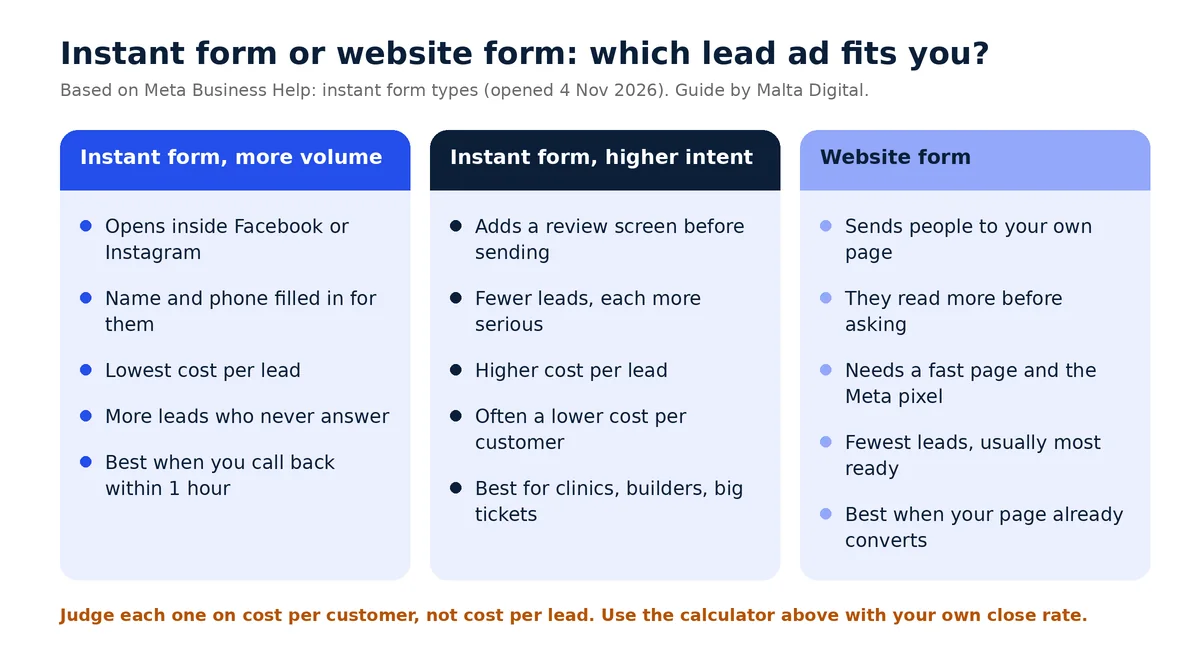
Quick rule. Can you call back within the hour and your sale is small? Use the volume form. Is each customer worth €500 or more? Use the higher intent form. Does your page already turn visitors into enquiries? Test the website form.
Free printable checklist (PDF, 1 page). Download the lead ads checklist
| If you… | Read or do next |
|---|---|
| want to set a budget first | Facebook ads budget in Malta |
| want to build the lead form | Facebook lead ads in Malta, step by step |
| are not sure leads are tracked | Meta Pixel and Conversions API |
| want to know the full monthly cost | Facebook ads management pricing |
| want us to run it | Meta ads management by Malta Digital |
Our help
When you apply, we look at your offer, your form and any past results. We work out your break-even CPL with you before we spend a euro. Then we set up the campaign, the form questions and the tracking, so every lead can be followed to a booking.
Each month you get a short report with leads, cost per lead and, where you share it, bookings and sales. The ad account stays in your name and you pay Meta directly. Our Meta ads management starts from €1,249 a month plus ad spend. If you want to choose with care, read our agency vs freelancer guide first, or see how lead forms work in Facebook lead ads in Malta.
A few straight answers
One that is below what a lead is worth to you: gross profit per customer × the share of leads that buy. A real Malta Digital campaign paid €9.68 per form lead, but yours depends on your offer and form.
Divide your ad spend by the number of leads for the same dates. €4,625.31 ÷ 478 leads = €9.68 per lead.
Common reasons are ads wearing out, a small audience seeing the same ad too often, a busy season, or big edits that restart the learning phase.
No. Cheap leads that never answer cost more in the end. Track cost per booking as well as cost per lead.
Instant forms inside Facebook often give more and cheaper leads. Website forms often give fewer leads who read more first. Test both with a qualifying question.
Give a new campaign 2 to 3 weeks, and ideally about 50 leads a week, before you judge it.
Meta’s cost per result only counts ad spend. For the full cost, add the fee. Malta Digital’s Meta ads management starts from €1,249 a month plus ad spend.
One well under what a customer leaves you. Divide your cost per lead by the share of leads that book. At €9.68 per lead and 2 in 5 booking, each booking costs about €24.
Yes, when you judge profit. Add the monthly fee to the ad spend, then divide by the leads. The calculator on this page does it for you.
Many Malta firms advertise to the same small audience. Busy seasons bring more bidders, so plan budget and offers around them.
Wait for at least 30 to 50 leads, or two weeks of spend. Smaller numbers swing too much to judge.
Keep reading
Set your budget from your goal, check it against Meta’s learning phase, and test it in a free budget planner.

Form setup, follow-up and judging cost per customer, not just cost per lead.
Free tool: enter your budget, cost per lead or sale, close rate, sale value and margin to see customers, ROAS and your break-even point. Your numbers only.
A useful first step
We work out your break-even cost per lead, run your Facebook and Instagram lead ads and report on leads and bookings every month. Meta ads management from €1,249 a month plus ad spend.
Step 1 of 2
A few quick questions, about a minute. We usually reply within 2–3 hours.