Shopify vs WooCommerce
Fees and running costs compared.
Websites · Online shops
Marketplaces bring buyers but take a cut of every sale. Your own shop keeps more but needs its own visitors. This guide shows the real fees, the Malta numbers, the rules and a free calculator, so you can choose with figures.
Most Malta businesses that sell online do best with both: a marketplace to be found by new buyers, and their own website shop to keep more of each sale and the customer. Marketplaces take a cut of every order (Etsy’s transaction fee is 6.5% plus payment processing), while your own shop has a monthly cost and card fees of about 1.5% + €0.25 per European card order, so it wins once orders grow and buyers come back to you direct. We build shops as part of our website design packages.
The short version
Most Malta businesses that sell online do best with two channels working together: a marketplace where new buyers can find them, and their own website shop where they keep more of each sale and the customer’s details. Marketplaces take a cut of every order, while your own shop has a fixed monthly cost and lower card fees, so the more of your buyers come back to you direct, the more your own shop pays for itself.
That is the whole decision in two sentences. The rest of this guide gives you the numbers behind it: how many Malta businesses already sell through their own website, what the main marketplaces charge in their own words, what a website shop costs to run, the tax reporting rule that now applies to marketplace sellers, and a free calculator that shows what you keep per month on each route.
If you already know you want your own shop, our guide to e-commerce websites in Malta covers the build, and our website design packages show what we deliver and when.
The market
Selling online is already normal here. Eurostat’s 2025 survey of businesses with 10 or more staff found that 30.5% of Malta businesses made web sales through their own website or app, against an EU average of 17.7%. Only 10.7% sold through online marketplaces (EU 9.3%), and 8.3% used both.
So in Malta, the own website is the main channel and the marketplace is the extra one, not the other way round. People are active sellers too: in 2025, 30.4% of people in Malta sold goods or services online, against 23.9% across the EU (Eurostat, isoc_ci_ac_i).
The shoppers are the other half of the story. Of people in Malta who bought online, 63.4% bought from sellers in other EU countries and 54.2% from sellers outside the EU, far above the EU averages of 32.8% and 20.1%. Malta buyers are used to ordering from abroad, which means your real competition is often a foreign shop, not the shop down the road.
That cuts both ways. Foreign shops are big and cheap, but they also let Malta buyers down: in 2025, 35.7% of people in Malta who bought online met a foreign seller that would not sell to Malta, against 5.4% across the EU, and 27.8% had a delivery slower than promised (Eurostat, isoc_ec_iprb21). A local shop that shows a clear price, delivers fast to Malta and Gozo and answers messages has a real edge.
Your options
Here is how the four routes compare on the points that matter to a small business. None is wrong; they do different jobs.
| Point | Marketplace | Your own website shop | Social selling | All together |
|---|---|---|---|---|
| Who brings the buyers | The marketplace | You, through Google, ads and your list | Your followers | Each channel feeds the others |
| What you pay | A cut of each sale, often plus listing and payment fees | A monthly running cost plus card fees | Your time, and ads if you boost | A mix of both |
| Who owns the customer | The marketplace, mostly | You: email, phone, order history | You, but spread over chats | You, once they buy direct |
| Your brand | Your shop sits next to rivals | Fully yours | Yours, inside the app’s layout | Strongest overall |
| Rules you follow | The marketplace’s, which can change | Consumer law and your own terms | The app’s rules and consumer law | All of them |
| Best for | Being found by new buyers abroad | Repeat customers and better margin | Testing what sells | Shops that want to grow |
Social selling deserves a word. Many Malta shops start by posting on Instagram and taking orders by message, and that is a fine way to test demand. But Facebook and Instagram Shops are not available to Malta businesses, so you cannot check out inside the app; our guide to Facebook and Instagram shops in Malta explains what to set up instead.
Marketplace fees
Fees change and differ by country, so always read the fee page for your own account before you decide. Here is what two of the best-known marketplaces publish.
| Marketplace | Fee | What it covers |
|---|---|---|
| Etsy | $0.20 per listing | Charged when you publish a listing, whether or not it sells |
| Etsy | 6.5% transaction fee | On the total order amount, including postage and gift wrap |
| Etsy | Payment processing fee | Varies by the country of your bank account |
| Etsy | Set-up fee and Offsite Ads fees | Set-up fee varies by location; Offsite Ads charge a fee on sales they bring |
| Amazon (UK pricing page) | £0.75 per unit sold, or £25 a month | Individual plan, or Professional plan whatever you sell |
| Amazon (UK pricing page) | Referral fee, most between 8% and 15% | A share of the total price, including shipping and gift wrap, set by category |
Two things stand out. First, the cut is charged on the whole order, delivery included, so a €45 order with €5 delivery pays on €50. Second, the headline fee is never the only one: payment processing, listing fees and optional ads all add up. Put your real rates into the calculator below, not the headline figure.
What you get for that money is real, though: buyers who are already looking, trust in a known checkout and, on some marketplaces, help with delivery. For a maker in Gozo selling to tourists who have gone home, that reach can be worth the cut.
Want to know what a marketplace really costs you compared with your own shop? Apply now for an online shop
Your own shop
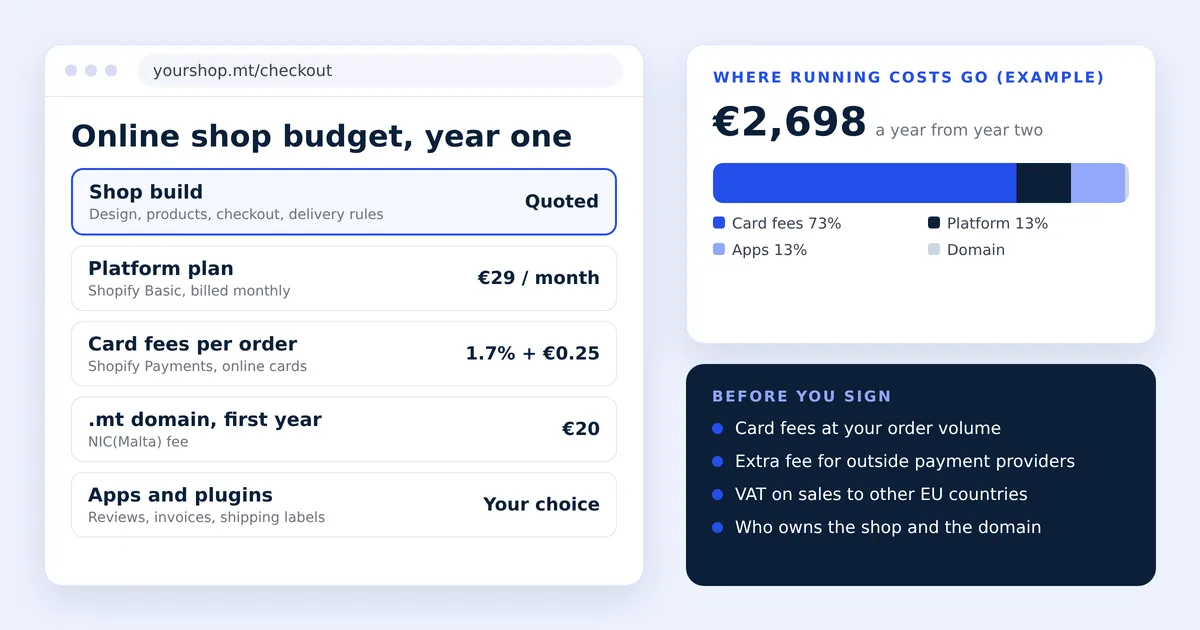
Your own shop swaps the per-sale cut for fixed costs. The main lines are the build, a monthly platform or hosting cost, apps or extensions, a domain and card fees. Card fees are low compared with marketplace cuts: Stripe’s published Malta pricing is 1.5% + €0.25 for standard European cards, with higher rates for premium and non-European cards.
| Cost | How it is charged | Where to check |
|---|---|---|
| Platform or hosting | A monthly plan | Your platform’s or host’s pricing page |
| Apps or extensions | Monthly or yearly per app | Only buy what you use |
| Card fees | A percentage plus a fixed amount per order | Your payment provider’s pricing page |
| Domain | Yearly | Your registrar; see our guide to .mt domains |
| Marketing | Ads, emails and content that bring buyers | Your own budget; the shop does not bring traffic by itself |
| Care and updates | Monthly, or your own time | Who keeps the shop updated and tested |
The line people forget is marketing. A marketplace brings buyers; your own shop does not, at least at first. That is why the calculator asks for a marketing cost per order. For the full build and running costs, see our e-commerce website cost guide, and for the platform choice, our Shopify vs WooCommerce comparison.
In return you keep the customer. Every order gives you a name, an email and a reason to sell again, and repeat buyers cost far less to win than new ones. Malta shoppers buy often: in 2025, 20.6% of people in Malta made more than 10 online purchases in three months, about double the EU share of 9.5% (Eurostat, isoc_ec_ib20). Our product page checklist shows what makes them buy from you rather than a foreign site.
Free tool
Type in your orders, your average order including delivery, and the fees from your own marketplace account and payment provider. The calculator shows what you keep each month on a marketplace and in your own shop, and the order level where your own shop starts to win. The figures already filled in are only a starting point; replace them with yours.
Use your own figures. Nothing you type is sent anywhere.
Your result appears here as you type.
Where the answer flips depends mostly on one number: what it costs you to bring each buyer to your own shop. With the figures filled in above and €4 of marketing per order, the own shop only wins at about 500 orders a month. Cut that to €2 and it wins from about 24 orders; for repeat buyers who come straight to you, at no marketing cost, it wins from about 13. That is why your own shop and your customer list matter more than the fee table.
The rules
Selling online brings a few rules that apply wherever you sell. Here are the ones that catch small sellers out.
| Rule | What it means for you | Source |
|---|---|---|
| Marketplaces report sellers to the tax authorities | A marketplace must report your sales details if you make 30 or more sales of goods, or more than €2,000, in a year on that platform | Council Directive (EU) 2021/514 (DAC7); in Malta S.L. 123.127, reports go to the MTCA |
| Marketplaces must say if a seller is a trader | Buyers see whether you sell as a business; if you do, consumer law applies to you | Directive (EU) 2019/2161 |
| 14 days to cancel | Consumers can cancel most online purchases within 14 days without a reason | Directive 2011/83/EU, art. 9; S.L. 378.17 |
| Clear information before the order | Your identity, total price with delivery, delivery terms and the cancellation right | Directive 2011/83/EU, art. 6; S.L. 378.17 |
| Two-year legal guarantee | Goods must match the description and work as expected | Directive (EU) 2019/771 |
| Personal data | Customer names, addresses and emails need a lawful basis and protection | Regulation (EU) 2016/679 (GDPR) |
The DAC7 rule surprises people who sell “on the side”. It does not create a new tax, but it means the tax authorities will see your marketplace sales, so treat regular selling as a business from the start and speak to your accountant. Our tax guide for online shops covers the sales tax side, and our guide to website legal requirements in Malta lists the pages your own shop needs.
Delivery
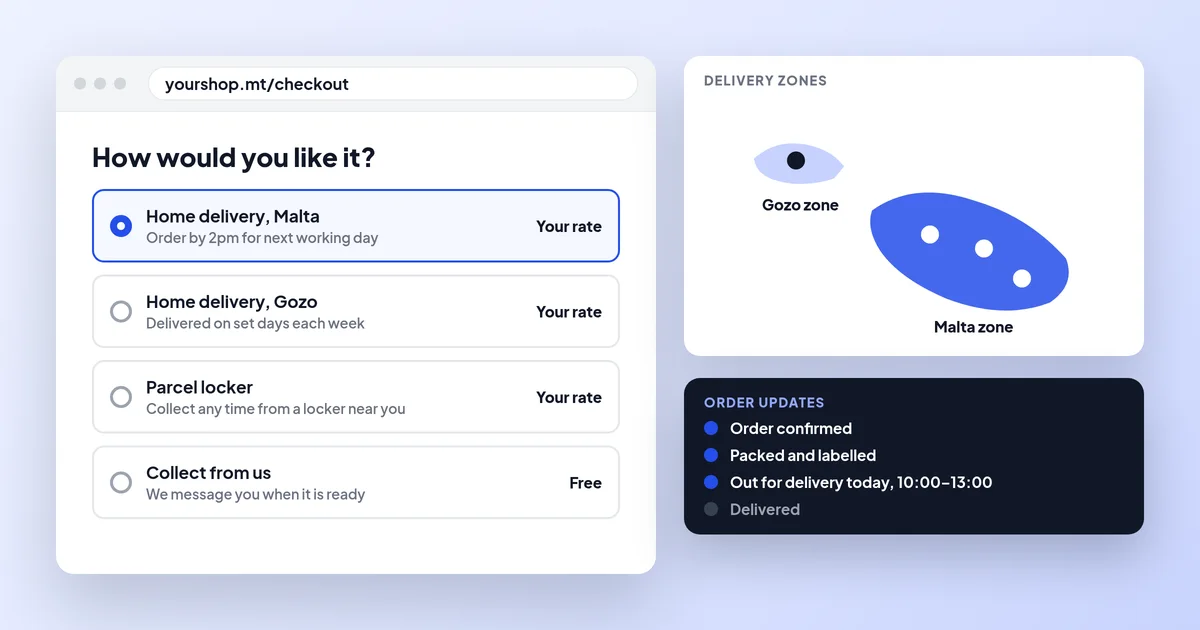
Delivery is the one place a local seller can beat a giant. Foreign shops often refuse Malta, charge high delivery or take weeks. You can offer next-day delivery in Malta, set days for Gozo and click and collect.
| Choice | Good for | Watch out for |
|---|---|---|
| Your own delivery | Small areas, bulky items, same-day | Your time and fuel; set clear days and areas |
| Local courier or postal service | Steady volume across Malta and Gozo | Pick-up times and Gozo days |
| Parcel lockers | Customers who are out at work | Size limits |
| Click and collect | Shops with a counter or studio | Opening hours shown clearly |
| Marketplace delivery schemes | Selling abroad at volume | Fees and stock rules set by the marketplace |
Whatever you choose, show the delivery cost and day before checkout. Eurostat found that 10.1% of people in Malta who bought online in 2025 had final costs higher than shown, against 4.5% across the EU. Our online shop delivery guide compares the carriers, costs and Gozo options in detail.
Want a shop with Malta and Gozo delivery set up properly from day one? Apply now for an online shop
Worked examples
Example 1: a ceramics maker in Gozo. Say a maker sells 40 pieces a month at an average of €45 including delivery, all on a marketplace that charges 6.5% plus a payment fee of 4% + €0.30 and about €10 a month in listing fees. Each month the fees come to about €211, so she keeps about €1,589 of €1,800. Her own shop would cost, say, €60 a month to run, card fees of 1.5% + €0.25 and €4 of marketing per order: about €257 a month, so she would keep about €1,543. At 40 orders the marketplace still wins, narrowly.
Now say half her buyers are repeat customers who found her on the marketplace and would happily buy direct. If she moves those 20 orders a month to her own shop, she pays no marketing on them and still keeps the marketplace for new buyers. That mix is where most makers end up.
Example 2: a clothing boutique in Sliema. Say a boutique sells 150 orders a month at €60 through Instagram messages and bank transfers. Orders get lost, sizes are asked twice and nobody knows what sold. With her own shop, card fees of 1.5% + €0.25 come to about €173 a month, plus €60 running cost. A marketplace charging 15% would take €1,350 a month on the same sales. Here the own shop, with click and collect at the counter and Instagram posts linking to product pages, is the clear choice.
The numbers in both examples are examples only. Use the calculator above with your own fees, because rates differ by marketplace, category and country.
Step by step
If you sell services rather than products, a shop may not be what you need; our guide to small business websites in Malta covers enquiry-led sites instead.
How we help
We build online shops for Malta and Gozo businesses on the platform that fits how you sell, with card payments, delivery zones for Malta and Gozo, clear product pages and the consumer wording the law asks for. You own the shop, the domain and the customer list, and we can connect it to the marketplace you already use.
| Package | Price | Ready in |
|---|---|---|
| Professional Website | From €990 | Complete in 24 to 48 hours |
| Business Website | From €2,490 | 2 to 4 days |
| Growth Website | From €4,900 | 7 days |
| 24-Hour Premium Website | €2,990, up to 15 pages | 24 hours |
| Online shop | Quoted after a short call | Depends on your catalogue |
Shops are quoted after a short call because the work depends on how many products you have and how you deliver. We have 18 Google reviews from real clients. If you also want buyers sent to the shop, our Facebook and Instagram ads start at €1,249 a month plus ad spend. See our website design packages for what each one includes.
Ready to sell online with a shop you own? Apply now for an online shop
A few straight answers
For most growing businesses, both. A marketplace helps new buyers find you, while your own website shop keeps more of each sale and the customer’s details. Which keeps more depends mostly on what it costs you to bring each buyer to your own shop; repeat buyers who come straight to you are where your own shop wins.
Etsy’s help centre lists a listing fee of $0.20 per listing and a transaction fee of 6.5% of the total order amount, including postage and gift wrap. A payment processing fee is added and varies by the country of your bank account, and a set-up fee may apply.
Yes, above a threshold. Under the EU DAC7 rules, in force in Malta through S.L. 123.127, marketplaces must report sellers who make 30 or more sales of goods or more than €2,000 in a year on that platform, and reports go to the MTCA.
No. Facebook and Instagram Shops are not available to businesses in Malta. You can post products and take orders by message, or link your posts to your own website shop with a Meta catalogue for ads.
That depends on your payment provider. Stripe’s published Malta pricing is 1.5% + €0.25 for standard European cards, with higher rates for premium and non-European cards. Check your provider’s pricing page for your exact rates.
Yes, for most goods sold to consumers. EU and Maltese law give buyers 14 days to cancel a distance purchase without giving a reason, with some exceptions such as made-to-order or sealed hygiene items, plus a two-year legal guarantee.
Our website packages start from €990, but online shops are quoted after a short call because the work depends on your products, payments and delivery. You own the shop, the domain and the customer list.
Sources
Keep reading
Fees and running costs compared.
Carriers, costs and Gozo.
What a shop costs to build and run.
A useful first step
Professional Website from €990, Business Website from €2,490 and Growth Website from €4,900; online shops are quoted after a short call. Tell us about your products and we reply with what we would build.
Step 1 of 2
A few quick questions, about a minute. We usually reply within 2–3 hours.