Shopify in Malta
Set-up, payments and delivery.
Websites · Online shops
Both platforms work for a business in Malta. This guide compares them side by side, explains payments and fees, lists every running cost, covers the Malta points both leave to you, and has a free calculator for your own numbers.
Choose Shopify if you want a quick, low-maintenance shop with hosting and checkout handled for a monthly fee, and use Shopify Payments to avoid its extra fee of up to 2% per sale. Choose WooCommerce if you already run WordPress, need custom features or want full control, and have someone to keep it updated. We build on either as part of our website design packages.
The short version
Choose Shopify if you want a shop that is quick to launch and easy to run, with hosting, security and checkout handled for you for a monthly fee. Choose WooCommerce if you already run WordPress, need custom pricing, B2B rules or bookings, or want full control of your code and data, and you have someone to keep it updated.
Both work for a business in Malta. Shopify lists Malta as a supported country for Shopify Payments, and WooCommerce’s own payment service, WooPayments, lists Malta too, alongside Stripe and PayPal. So the choice is not about whether you can take cards. It is about who runs the platform, what it costs over a few years and how much you need to change.
This guide compares the two side by side, explains payments and the extra fee Shopify adds if you use another provider, lists every cost to count, has a free calculator for your own numbers, and covers the Malta points both platforms leave to you. Whichever you pick, the shop is part of the wider plan in our website design for Malta businesses.
The market
Businesses in Malta sell online far more than the EU average. In Eurostat’s 2025 survey of enterprises with ten or more staff, 30.5% of Malta businesses made web sales through their own website or app, against 17.7% across the EU. Selling through marketplaces was much closer to the EU level, at 10.7% in Malta and 9.3% in the EU.
In other words, Malta businesses prefer their own shop to a marketplace. That makes the platform decision more important here, because your own shop carries your brand, your customer list and your margins. Getting the platform wrong usually shows up a year later, as a pile of monthly app fees on one side or a slow, unpatched site on the other.
Shoppers are demanding too. Eurostat’s 2025 figures show that people in Malta who bought online met more problems than the EU average, from slow delivery to sites that are hard to use. Our product page checklist shows how to prevent those on either platform, and our guide to e-commerce websites in Malta covers the rest of the shop.
Side by side
Here is how the two compare on the points that matter to a small shop in Malta. Neither column is “better”; each suits a different kind of business.
| Shopify | WooCommerce | |
|---|---|---|
| What it is | A hosted shop you rent for a monthly plan | Free, open-source shop software added to a WordPress site you host |
| Hosting and security | Included, with SSL; Shopify is PCI DSS Level 1 | You choose and pay for hosting; updates and backups are your job |
| Platform fee | Monthly plan, priced by country and billing period | None for the software itself |
| Payments in Malta | Shopify Payments listed for Malta; other providers add a Shopify fee | WooPayments lists Malta; Stripe, PayPal and bank gateways via plugins |
| Extra fee per sale | 0.2% to 2% if you do not use Shopify Payments | None from WooCommerce |
| Add-ons | App store; many apps charge monthly | Plugins and extensions; many paid yearly |
| Custom features | Good within themes and apps; deep changes are limited | Almost anything, if someone builds and maintains it |
| Content and blog | Basic blog and pages | Full WordPress for guides and landing pages |
| Who keeps it running | Shopify runs the platform | You or your developer |
| Data and moving | Export products, customers and orders as files; theme and apps stay | You hold the database and files, and can move host |
If you are still deciding whether you need a shop at all, or whether a simpler site with an enquiry form would do, read our comparison of WordPress, Wix and custom websites and our guide to Shopify in Malta, which covers Shopify set-up for Malta in detail.
Not sure which platform fits your shop? Apply now for an online shop
Payments
On Shopify, the natural choice is Shopify Payments. Shopify’s help centre lists Malta among the supported countries, subject to its checks on your business and documents. If you use a different provider instead, Shopify adds its own third-party transaction fee on top of that provider’s fees. The fee depends on your plan.
| Shopify plan | Extra fee on each sale |
|---|---|
| Basic | 2% |
| Grow | 1% |
| Advanced | 0.6% |
| Plus | 0.2% |
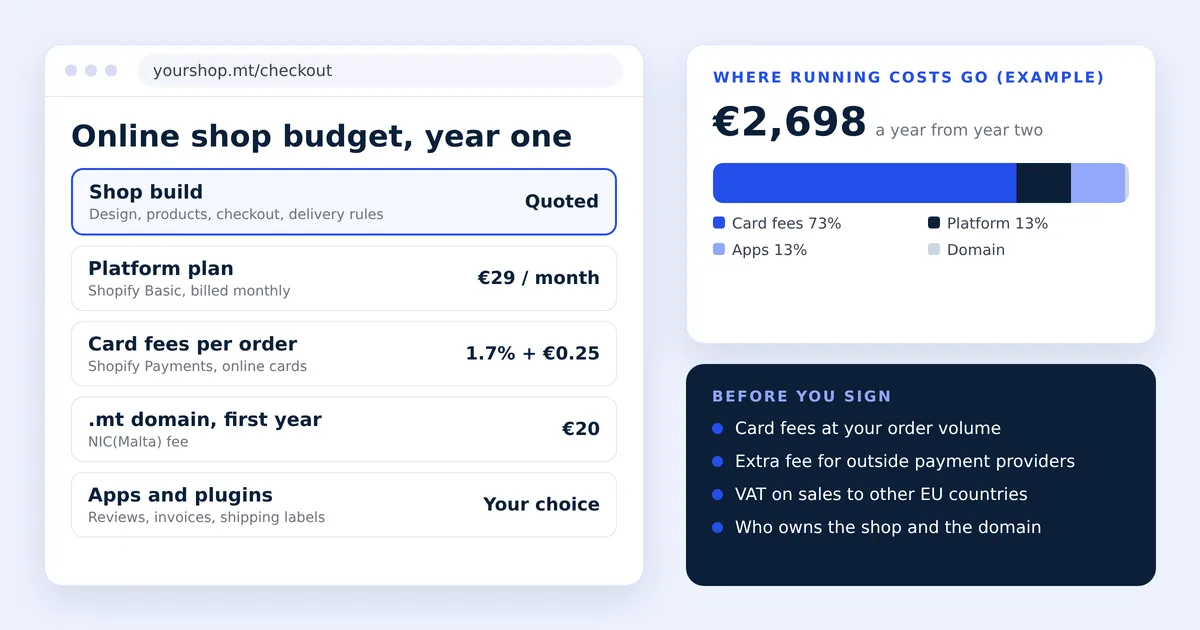
On a shop selling €6,750 a month, that 2% on Basic is €135 a month, or €1,620 a year, before the provider’s own card fees. That is why almost every Shopify shop uses Shopify Payments. Its card rates depend on your plan and are shown on Shopify’s pricing page for your country, so check them when you sign up.
On WooCommerce there is no platform fee on sales. WooCommerce’s WooPayments lists Malta as a supported country, and Stripe has an official WooCommerce plugin. Stripe’s published Malta pricing is a good benchmark for card costs on a WooCommerce shop.
| Card type | Stripe fee in Malta |
|---|---|
| Standard European Economic Area cards | 1.5% + €0.25 |
| Premium European Economic Area cards | 2.8% + €0.25 |
| UK cards | 2.5% + €0.25 |
| International cards | 3.15% + €0.25 |
| Dispute received | €20.00 each |
Most Maltese shoppers pay with a standard European card, so the 1.5% + €0.25 line is the one that matters most. Our payment gateway guide for Malta compares Stripe, PayPal, Shopify Payments and bank gateways in more detail.
Real costs
Comparing a Shopify plan with “free” WooCommerce is the most common mistake. Both have running costs; they just sit in different places. Count every line below for both platforms, over at least three years, before you decide.
| Cost line | Shopify | WooCommerce |
|---|---|---|
| Platform | Monthly or yearly plan | None for the software |
| Hosting | Included | Hosting plan that can handle a shop |
| Domain | Your own domain, connected | Your own domain |
| Theme | Free or paid theme | Free or paid theme |
| Add-ons | Monthly app fees | Yearly extension licences |
| Card fees | Shopify Payments rate, or provider fee plus Shopify’s fee | Provider fee only |
| Updates and security | Handled by Shopify | Updates, backups and checks, by you or a developer |
| Changes later | Theme and app limits; developer for custom work | Developer for anything custom |
The pattern is simple. Shopify costs more in fixed monthly fees and less in your own time. WooCommerce costs less in fixed fees and more in care: if nobody updates the plugins and tests the checkout after changes, the savings disappear the first time something breaks on a Saturday. Our website hosting guide explains what to look for in hosting if you go the WooCommerce route, and our website security guide covers updates and backups.
Free tool
Type your own figures: orders, average order, the Shopify plan price you see on its pricing page, and the hosting and care quotes you have for WooCommerce. The calculator compares running costs over the years you choose, including card fees and Shopify’s extra fee if you pick another provider. One-off build costs are left out, because they depend on your catalogue. Nothing you type is sent anywhere.
Use your own figures. Nothing you type is sent anywhere.
Your result appears here as you type.
If the two totals come out close, pick on the other points: who will run it day to day, whether you need custom features, and how much content you plan to publish. If Shopify comes out far ahead only because the WooCommerce care line is high, ask whether you really need that level of care for a small catalogue.
Worked examples
Example 1: the 2% that nobody noticed. Say a Sliema clothing shop on Shopify Basic takes 150 orders a month at an average of €45, so €6,750 a month. It connected Stripe instead of Shopify Payments. Stripe charges 1.5% + €0.25 on a standard EEA card, so about €138.75 a month. Shopify then adds its 2% third-party fee, €135 a month. Over three years, that extra fee alone is €4,860. Switching to Shopify Payments, or checking whether its rate is lower than the combined cost, is the first thing to do.
Example 2: the content-led shop. Say a Gozo food producer already has a WordPress site with recipes and guides that bring visitors from Google. Moving to Shopify would mean rebuilding that content on a separate platform. Adding WooCommerce to the existing site keeps the content and the shop in one place, with Stripe taking payments at 1.5% + €0.25 and no extra platform fee. The trade-off is that the producer now needs someone to update WordPress and the shop plugins and test the checkout after each update.
In both cases the numbers only tell half the story. The other half is who will run the shop. Online shops we work on are built to be run by the owner day to day; one store tracked €573k in sales from €95k of ad spend, which you can read about in our e-commerce case study.
Want a shop on the platform that fits how you work? Apply now for an online shop
Ownership
Whatever platform you choose, register the domain in your own name and keep the login. Our guide on who owns your website explains why this matters more than the platform itself.
Malta specifics
Neither platform knows your business. These Malta points need setting up on either one, and they matter more than the platform choice.
| Point | What to set up |
|---|---|
| Tax on what you sell | Tax settings agreed with your accountant before launch; see our VAT guide for online shops |
| Delivery zones | Malta and Gozo as separate zones with their own costs and days; collection if you offer it |
| Consumer rules | Total price, delivery costs, 14-day withdrawal, guarantee wording and a clear “Buy now” button |
| Price reductions | “Was” prices that follow S.L. 378.09 regulation 5A (lowest price of the last 30 days) |
| Language | English first; a Maltese or Italian version if your buyers need it |
| Accessibility | The European Accessibility Act applies to online shops from 28 June 2025; very small businesses are exempt, but an accessible checkout sells better |
For delivery options and carriers, see our online shop delivery guide, and for the legal pages around the shop, our website legal requirements guide.
Checklist
If you answer “it depends” to most of these, that is normal. A short call usually settles it in fifteen minutes once we see the catalogue.
How we build it
We build shops on the platform that fits how you work, not the one we prefer. You own the domain, the shop and the customer list, and we set up payments, Malta and Gozo delivery zones, consumer wording and tracking before launch. Shops are quoted as their own scope after a short call, once we see your catalogue.
| Package | Price | Build time | Fits |
|---|---|---|---|
| Professional Website | From €990 | 24 to 48 hours | Up to 5 pages, products shown with an enquiry form |
| Business Website | From €2,490 | 2 to 4 days | More pages, product ranges, a second language |
| 24-Hour Premium Website | €2,990, up to 15 pages | 24 hours | A launch date that cannot move |
| Growth Website | From €4,900 | 7 days | Landing pages, tracking and a growth plan |
| Online shop | Quoted after a short call | Agreed in writing | Shopify or WooCommerce, catalogue, payments and delivery |
If neither platform fits, for example because of complex B2B pricing or stock held in several locations, a custom system starts from €7,500, with a first working version ready in 2 to 4 weeks. We have 18 Google reviews from real clients. For build costs, see our e-commerce website cost guide or our website design packages.
Ready to start your shop on the right platform? Apply now for an online shop
A few straight answers
Shopify is better if you want a quick, low-maintenance shop and will use Shopify Payments. WooCommerce is better if you already run WordPress, need custom features, or want full control of code and data and have someone to maintain it.
Yes. Shopify’s help centre lists Malta as a supported country for Shopify Payments, subject to its checks on your business and documents.
Yes. If you do not use Shopify Payments, Shopify adds a third-party transaction fee of 2% on Basic, 1% on Grow, 0.6% on Advanced and 0.2% on Plus, on top of the provider’s own fees.
The WooCommerce software is free, but you pay for hosting, a domain, any paid extensions, card fees and someone to keep WordPress and the plugins updated.
That depends on the provider. Stripe’s published Malta pricing is 1.5% + €0.25 for standard European cards and 3.15% + €0.25 for international cards, with no extra fee from WooCommerce.
Yes. Products, customers and orders can be moved in both directions. Plan redirects for every product address so you keep your Google positions, and expect to rebuild the design.
Yes. We build on the platform that fits how you work, set up payments, Malta and Gozo delivery and consumer wording, and you own the shop. Shops are quoted after a short call once we see your catalogue.
Sources
Keep reading
Set-up, payments and delivery.

Stripe, PayPal and banks compared.
What a shop costs to build.
A useful first step
Professional Website from €990, Business Website from €2,490 and Growth Website from €4,900; online shops are quoted after a short call. Tell us about your shop and we reply with what we would build.
Step 1 of 2
A few quick questions, about a minute. We usually reply within 2–3 hours.