
E-commerce websites in Malta
What an online store needs to sell.
Websites · Online shops
Shoppers in Malta buy online more often than most Europeans and meet more problems. This guide shows what a product page must say, the EU and Malta rules behind it, what Google needs, and a free checker for your own pages.
A product page sells when it answers four questions before the shopper asks: what exactly is this, can I trust this shop, what is the total cost and when will it arrive. Show sharp photos, the price with all taxes, delivery cost and days for Malta and Gozo, plain returns and guarantee wording, and one clear “Buy now” button. We plan shops this way as part of our website design packages.
The short version
A product page that sells answers four questions before the shopper has to ask: what exactly is this, can I trust this shop, what will it cost me in total, and when will it reach me. In Malta that means sharp photos of the exact item, a price with every tax included, the delivery cost and days for Malta and Gozo, plain returns and guarantee wording, and one clear order button.
Most small shops get the photos right and lose the sale on the last two questions. Shoppers in Malta have had more problems buying online than almost anyone in Europe, so they look hard for the details that protect them. The four steps below are the checks every buyer makes, usually in this order and usually on a phone.
This guide covers what Malta shoppers struggle with, the parts of a product page and what each must say, the consumer rules that apply to every product page, photos and descriptions, delivery and returns, what Google needs to show your products, and a free checker that scores your page. It sits alongside our website design for Malta businesses, where online shops are planned around exactly these points.
The data
People in Malta buy online a lot. In Eurostat’s 2025 survey, 20.6% of all people in Malta had bought online more than ten times in the previous three months, more than double the EU average of 9.5%. A third of people in Malta (33.3%) bought six times or more in that period, against 20.1% across the EU.
They also run into more trouble. Of the people in Malta who bought online in the last three months, 63.9% met at least one problem, against 35.4% across the EU. The problems are exactly the ones a good product page prevents: slow delivery against what was promised, wrong or damaged goods, a site that is hard to use, guarantee information that is hard to find and a final cost higher than the price shown.
One number stands out. 35.7% of Malta’s recent online buyers said a foreign seller would not sell to their country, compared with just 5.4% across the EU. Big shops abroad often skip Malta or charge heavily for it. A local shop that says clearly “delivered across Malta and Gozo in two working days” is answering a worry most of its buyers already have.
So the job of your product page is not to be clever. It is to remove doubt: show the real item, the real total and the real delivery date, and make it easy to see what happens if something goes wrong.
The parts
Every product page needs the same building blocks, whatever you sell. Here is what shoppers look for in each one and what to put there. Keep the first four above the fold on a phone: photo, name, price and the order button.
| Part | Shopper’s question | What to put there |
|---|---|---|
| Photos | Is this the exact thing I will get? | At least four photos: front, back or side, close-up of the detail, and the item in use or next to something for scale |
| Name | Is this the right model or size? | Brand, product type and the main feature, such as “Oak dining table, 180 cm, seats 8” |
| Price | What will I pay? | Final price with all taxes, a unit price where the law asks for one, and any genuine “was” price |
| Variants | Do you have it in my size or colour? | Size or colour named in words; photo, price and stock change when picked |
| Stock | Can I have it now? | In stock, low stock, or the date it comes back; never “in stock” when it is not |
| Delivery | When will it arrive and what does it cost? | Cost and working days for Malta and for Gozo, click and collect if you offer it |
| Description | Will it suit me? | Your own words: who it is for, what it solves, then a specs table |
| Reviews | Did other people like it? | Genuine reviews, and a line on how you check they come from buyers |
| Returns and guarantee | What if it goes wrong? | 14-day withdrawal, how returns work, and the two-year legal guarantee |
| Order button | How do I buy? | One clear button that makes it obvious the customer will pay |
Notice what is missing: a long story about your company, pop-ups on arrival and three different “special offer” banners. They push the parts that sell below the fold. If you want a wider view of how a whole shop should be laid out, our guide to e-commerce websites in Malta covers the home page, categories and checkout.
Want product pages that answer every question before the shopper asks? Apply now for an online shop
The rules
A product page is where most of the information the law asks for has to appear, because it must be given before the customer is bound by the order. The EU Consumer Rights Directive 2011/83/EU, which Malta applies through the Consumer Rights Regulations (S.L. 378.17), lists what a shop must tell a consumer before a distance sale. Malta’s Price Indication Regulations (S.L. 378.09) add the price rules.
| Rule | Source | What to show on the page |
|---|---|---|
| Main characteristics of the goods | Directive 2011/83/EU art. 6(1)(a); S.L. 378.17 | Clear description, specs, size, materials |
| Total price including taxes, plus delivery charges | Directive 2011/83/EU art. 6(1)(e) | Final price, and delivery cost or how it is worked out |
| Delivery arrangements and the date you will deliver by | Directive 2011/83/EU art. 6(1)(g) | Delivery days for Malta and Gozo |
| Delivery restrictions and payment methods, at the start of ordering | Directive 2011/83/EU art. 8(3) | “We deliver to Malta and Gozo only” and the cards or wallets you take |
| Right of withdrawal, 14 days | Directive 2011/83/EU arts. 6(1)(h) and 9 | How to cancel and who pays the return cost |
| Reminder of the legal guarantee | Directive 2011/83/EU art. 6(1)(l); Directive (EU) 2019/771 | At least two years for goods |
| Order button that shows an obligation to pay | Directive 2011/83/EU art. 8(2) | “Order with obligation to pay”, “Buy now” or similar, never just “Continue” |
| Prior price on any reduction | S.L. 378.09 reg. 5A; Directive 98/6/EC art. 6a | The lowest price of at least the last 30 days |
| Unit price for goods sold by quantity | Directive 98/6/EC; S.L. 378.09 | Price per kilo or per litre next to the selling price, in most cases |
Two rules catch small shops most often. The first is the order button: if it says “Continue” or “Submit”, the customer may not be bound by the order, because the directive says the button must make the obligation to pay clear. The second is the “was” price. Under regulation 5A of S.L. 378.09 a price reduction must show the prior price, and that prior price is the lowest price you charged in at least the 30 days before the reduction. A “was €120, now €80” where the item sold at €85 last week breaks it.
Reviews have their own rule. Since the EU’s 2019 consumer update, it is an unfair practice to say reviews come from real buyers without taking reasonable steps to check that they do. Add one plain line near your reviews explaining how you check them. Our guide to website legal requirements in Malta covers the pages around the product page, such as terms, privacy and cookies, and our VAT guide for online shops covers the tax side for sellers.
Photos and words
Photos do most of the selling. Shoot your own, in good light, on a plain background for the first photo and in use for the others. Show the detail people worry about: the stitching, the plug, the inside of the drawer, the label with the ingredients. Google’s own guidance for product images asks for several high-resolution images, and recommends a minimum of 50,000 pixels (width times height) and a mix of square, 4:3 and 16:9 shapes.
Write for the questions you already get by message and phone. If people keep asking “does it fit a 60 cm space?” or “is it dishwasher safe?”, that answer belongs on the page, near the top. Our website copywriting tips show how to write headlines and short paragraphs that people actually read.
Delivery and returns
Delivery is where Malta shops win or lose. Slower delivery than shown was the most common problem for Malta’s online buyers in 2025, at 27.8%. So promise what you can keep and show it on the product page, not just in the checkout.
| Item | Good example | Avoid |
|---|---|---|
| Malta delivery | “Delivered in 1 to 2 working days, €4, free over €60” | “Fast delivery” |
| Gozo delivery | “Gozo: 2 to 3 working days, €6” | Leaving Gozo out, then adding a fee at checkout |
| Collection | “Collect from our Mosta shop, ready in 2 hours” | Collection only mentioned after payment |
| Cut-off time | “Order by 1pm for next working day in Malta” | A cut-off that ignores public holidays |
| Returns | “Change your mind within 14 days; we collect for €5 or you drop it off” | “No returns” on goods that are not exempt |
| Guarantee | “Two-year legal guarantee; tell us if it stops working” | Implying the guarantee is only the maker’s |
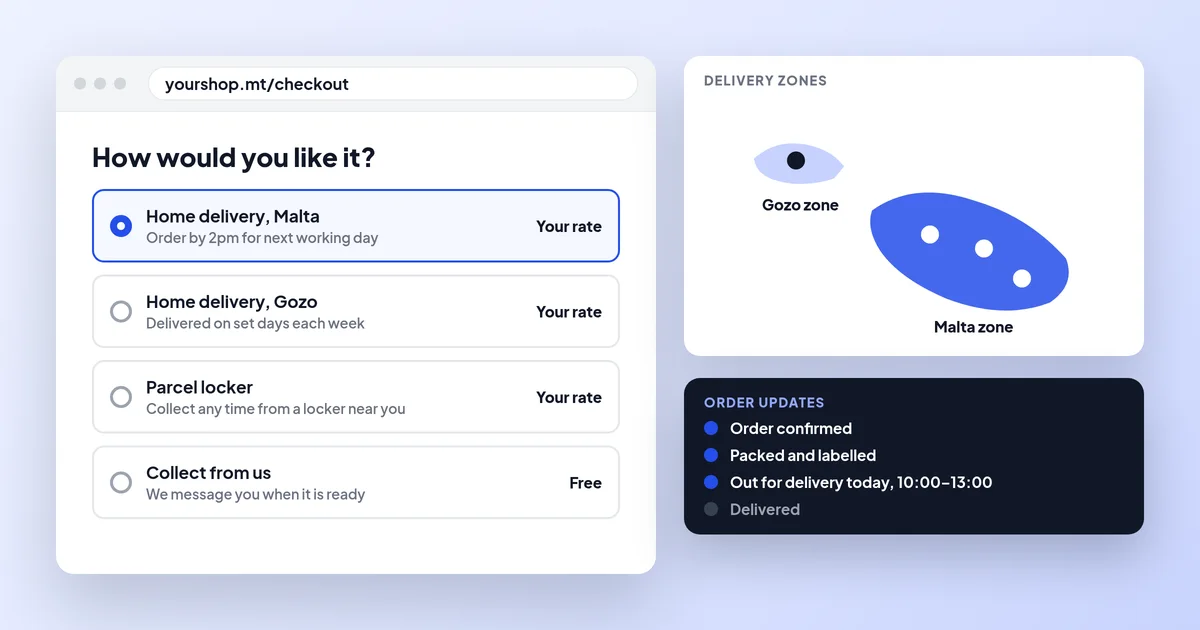
Put this block right under the order button, in four or five short lines with a link to the full policy. Shoppers in Malta will notice; many have been surprised by delivery fees from shops abroad. For carriers, costs and Gozo options, see our online shop delivery guide for Malta, and for the checkout itself, our payment gateway guide. If you have not picked a platform yet, our Shopify vs WooCommerce comparison sets out the running costs of each.
Google can show your products with price, stock and delivery right in the search results and in the Shopping tab, for free, if it understands the page. Two things help: product structured data on the page, and a free Merchant Center account with your product feed. Google’s documentation for merchant listings lists three required properties, and several recommended ones that make a listing richer.
| Property | Required or recommended | What it holds |
|---|---|---|
| name | Required | The product name |
| image | Required | URLs of crawlable product photos |
| offers (Offer) | Required | Price and currency, and you must be the seller |
| offers.availability | Recommended | In stock, out of stock, pre-order |
| offers.shippingDetails | Recommended | Delivery cost and time by destination |
| offers.hasMerchantReturnPolicy | Recommended | Return window and method |
| brand.name, gtin, sku | Recommended | Brand and product identifiers |
| aggregateRating, review | Recommended | Only genuine reviews, following Google’s review snippet rules |
The price, stock and delivery in the code must match what the page shows; if they differ, Google may drop the listing. Most shop platforms add basic product data automatically, but delivery and returns are often missing, so check one product in Google’s Rich Results Test. For the business side of structured data, see our local business schema guide. Speed matters too: a product page with ten uncompressed photos is slow on mobile data, so size images for phones.
Free tool
Pick one of your best-selling products, open its page on your phone, and tick what it really shows. The checker gives a score out of 100, weighted towards what the law asks for and what Malta buyers struggle with, and tells you what to fix first. Nothing you type is sent anywhere.
Use your own figures. Nothing you type is sent anywhere.
Your result appears here as you type.
A score under 60 usually means the page is losing sales to doubt, not to price. Fix the top three items first; they tend to be the total price, delivery days and the order button wording. Then do the same check on your next five best sellers, because most shops use one template for every product.
Worked examples
Example 1: a homeware shop in Mosta. Say the shop sells 120 products online. Its product pages have two supplier photos, the supplier’s description, the price, and a “Continue” button; delivery appears only at checkout. The checker scores it 15 out of 100. The fixes, in order: change the button to “Buy now”, add delivery cost and days for Malta and Gozo under it, add a short returns and guarantee block, then shoot two more photos per best seller and write two sentences of its own text. None of this needs a new platform. It is template work plus a few days of photos and writing.
Example 2: a food producer in Gozo. Say a Gozo producer sells honey, jams and olive oil in jars of different sizes. Food sold by weight or volume needs a unit price in most cases, so the 250 g jar at €6 also shows €24.00 per kg. The page lists ingredients and allergens in the specs table, shows “Gozo: next working day; Malta: 2 working days”, and names the order cut-off. The producer adds genuine reviews with a line that only verified buyers can leave one. Its score moves from about 40 to above 90.
Shops that fix product pages also get more from their ads. One online store we work with tracked €573k in sales from €95k of ad spend; you can read how in our e-commerce Meta ads case study. Ads bring the visitors; the product page decides whether they buy.
Want us to fix your product pages, or build the shop around them? Apply now for an online shop
Mistakes
| Mistake | What it costs you | Fix |
|---|---|---|
| Price without delivery | Basket abandoned at checkout | Delivery cost to Malta and Gozo on the page |
| “Continue” as the order button | Orders that may not bind the buyer | “Buy now” or “Order with obligation to pay” |
| A fake “was” price | Breaks S.L. 378.09 and trust | Lowest price of the last 30 days, or no “was” price |
| Supplier text copied | Same words as many other sites | Two sentences of your own, then specs |
| One small photo | Buyers cannot judge quality | Four or more sharp photos, one showing scale |
| “In stock” when it is not | Refunds, angry messages, bad reviews | Stock that updates, or a back-in date |
| No returns wording | Doubt, and more questions by message | 14-day withdrawal and guarantee in clear, simple terms |
| Colour dots without names | Wrong orders and returns | Name each variant in words |
If your whole shop needs more than a template fix, our website redesign guide explains how to rebuild without losing the Google positions you already have.
Step by step
For launch-day checks on the whole site, use our website launch checklist.
How we build it
We plan online shops around the product page first: the photos, the price and delivery block, the returns wording and the order button, then the categories and checkout around them. You own the domain, the shop and the customer list. Shops are quoted as their own scope after a short call, once we see your catalogue, because 20 products and 2,000 products are very different jobs.
| Package | Price | Build time | Fits |
|---|---|---|---|
| Professional Website | From €990 | 24 to 48 hours | Up to 5 pages to show products and take enquiries |
| Business Website | From €2,490 | 2 to 4 days | More pages, product ranges, a second language |
| 24-Hour Premium Website | €2,990, up to 15 pages | 24 hours | A launch date that cannot move |
| Growth Website | From €4,900 | 7 days | Landing pages, tracking and a plan to grow sales |
| Online shop | Quoted after a short call | Agreed in writing | Full catalogue, checkout, delivery and returns |
Need stock, orders and suppliers in one place built just for you? That is a custom system from €7,500, with a first working version ready in 2 to 4 weeks. We have 18 Google reviews from real clients. To compare costs first, read our e-commerce website cost guide for Malta, or see our website design packages.
Ready for product pages that turn visitors into orders? Apply now for an online shop
A few straight answers
Sharp photos of the exact item, a clear name, the price with all taxes, delivery cost and days for Malta and Gozo, stock status, your own description and specs, genuine reviews, returns and guarantee wording, and one clear order button.
The EU Consumer Rights Directive requires the total price and any delivery charges before the order is placed. Showing delivery cost and days on the product page itself avoids surprises at checkout, which Malta shoppers report more often than the EU average.
It must make clear that pressing it means paying, for example “Buy now” or “Order with obligation to pay”. A button that only says “Continue” or “Submit” does not meet Article 8(2) of the Consumer Rights Directive.
Show the prior price next to the reduced price. Under regulation 5A of S.L. 378.09, the prior price must be the lowest price you charged in at least the 30 days before the reduction.
At least four: the front, another side, a close-up of the detail that matters, and one showing scale or use. Google recommends several high-resolution images of at least 50,000 pixels.
It is not required by law, but Google’s merchant listings need name, image and an offer with price to show your product with price and stock in search. Delivery and return details make the listing richer.
Yes. We can fix the template on most shop platforms, or plan a new shop around better product pages. Shops are quoted after a short call once we see your catalogue; brochure websites start from €990.
Sources
Keep reading
What an online store needs to sell.
Carriers, costs and Gozo.
What sellers in Malta need to know.
A useful first step
Professional Website from €990, Business Website from €2,490 and Growth Website from €4,900; online shops are quoted after a short call. Tell us about your shop and we reply with what we would build.
Step 1 of 2
A few quick questions, about a minute. We usually reply within 2–3 hours.