CRM for Accountants in Malta: Clients, Deadlines, Documents
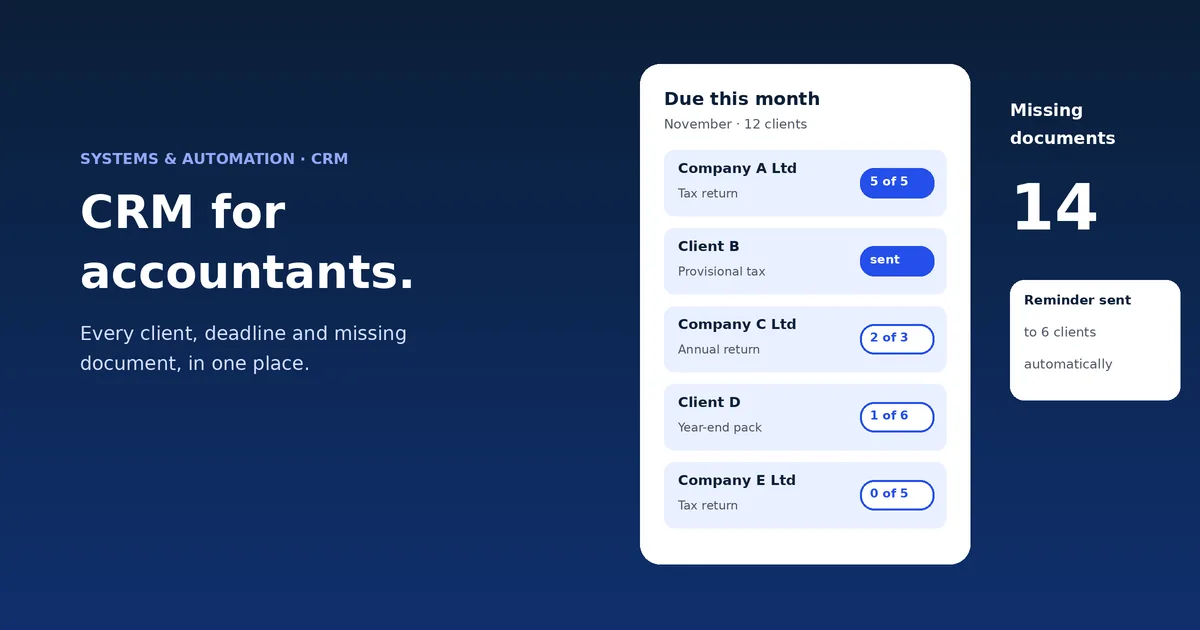
How accounting firms in Malta use a CRM for enquiries, onboarding and due diligence, deadlines and document chasing, plus a free deadline and chasing planner.
Systems & AI · Law firms
Malta Digital builds CRM in Malta for firms that win work from enquiries, and law firms depend on them more than most. A good enquiry still needs a reply, a conflict search, a decision and the right documents before any work starts. This guide shows what a law firm CRM should hold, the Malta rules it can keep for you, a worked example and a free planner.
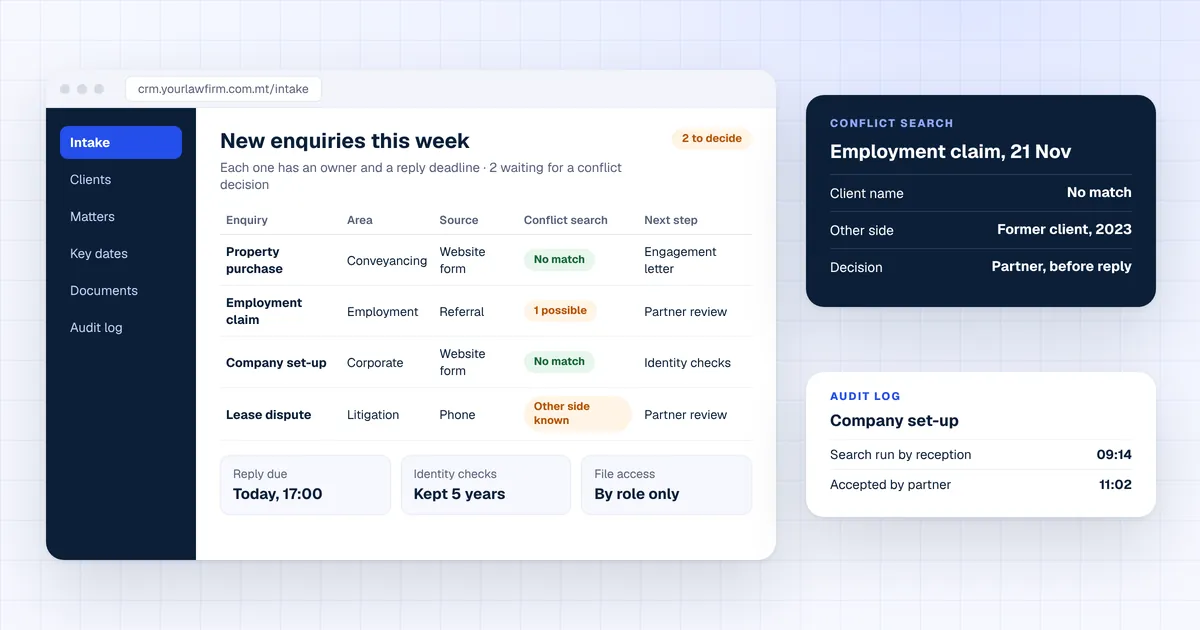
A CRM for a law firm keeps every enquiry, client, related party, decision and key date in one place. It runs the conflict search before anyone replies, records who accepted the work and keeps identity documents with the matter. In Malta, the Code of Ethics and Conduct for Advocates bars acting where interests conflict, and S.L. 373.01 asks for identity records to be kept for five years when the work is in scope. Malta Digital builds law firm CRMs that connect to the tools you already use, from €7,500.
The short version
Most firms lose work before the first meeting. An enquiry waits in a shared inbox, nobody owns it, and the client hires the firm that replied first.
Website, email, phone and referrals land in one list, each with an owner and a reply deadline.
Client, other side and related parties are checked against every past and present matter.
Who accepted or declined the work, when and why, saved on the record.
ID, proof of address and ownership papers stay with the client, not in an inbox.
Hearings, filing dates and renewals become tasks with reminders, never just a diary note.
Which referrers and which pages bring the matters you actually want.
A CRM is not your case management or accounts system. It is the front door and the client record that the rest of the firm works from.
Malta rules
Advocates in Malta work under the Code of Ethics and Conduct for Advocates. The Chamber of Advocates explains that it binds advocates with the force of law. Two parts matter most for a CRM: conflicts and confidentiality.

Chapter II, rule 7 says an advocate must not act where interests conflict between the advocate and a client, or between existing or prospective clients. Chapter V adds that you must not act against a former client when you hold relevant knowledge about them. A conflict search is only as good as the names it can search, so the CRM has to hold every party, not just the client.
Keep it clear
Firms often expect one system to do everything. A clear split works better and costs less.
Connect, do not copy. A custom CRM can link to your document storage, email and accounts package, so a new matter opens in each one without retyping. Our guide to CRM integration shows how.
Apply now and tell us how many enquiries you get, your practice areas and how you run conflict searches today. We reply with what we would build first.
Free tool
Put in your enquiries, intake time, conversion rate and average fee. The planner works out the hours a CRM could free and what faster replies could be worth. Nothing you type leaves this page.
Starting numbers match the worked example below. Replace them with yours.
Your result appears here as you type.
The rules
Each rule becomes a setting, a required field or a step that cannot be skipped.
| Rule | What it says | What the CRM does |
|---|---|---|
| Code of Ethics, Chapter II, rule 7 | Do not act where interests conflict between the advocate and a client, or between existing or prospective clients | Searches every party before a reply and blocks the matter until a match is cleared |
| Code of Ethics, Chapter V, rules 1 and 2 | No conflicting briefs, and no acting against a former client using relevant knowledge | Keeps former clients and other sides searchable for good |
| Code of Ethics, Chapter VI, rules 1 to 3 | Keep client affairs confidential, make sure staff do too, until the client waives it | Gives access by role and matter, with a log of who opened what |
| S.L. 373.01, regulations 2 and 13 | Advocates are subject persons for some transactions, such as property and company deals; records are kept for five years | Flags in-scope work, collects identity documents and keeps them with the matter |
| GDPR, articles 5 and 28 | Use only the data you need, and have a contract with any processor | Asks only for the fields you need and runs on a provider with a data processing agreement |
AI intake needs a notice. If an AI assistant answers enquiries on your website, Article 50 of the EU AI Act asks for people to be told they are talking to an AI system. Those transparency rules apply from 2 August 2026. Keep legal advice with your advocates.
The workflow
Here is how work moves through a firm with a CRM at the front door.
Accounting practices follow the same pattern. Our guide to a CRM for accountants shows how they handle identity checks and deadlines.
Worked example
Here is an example firm, not a client. It gets 60 enquiries a month and spends about 25 minutes on each one for intake and the conflict search. These are the planner’s starting numbers, so you can change them.
| Item | Today | With a law firm CRM | Difference |
|---|---|---|---|
| Intake and conflict search | 60 enquiries, 25 minutes each by hand | Half the steps done by the CRM: forms, searches, reminders | about 12.5 hours a month |
| Enquiries that become clients | 25%, so 15 a month | 27% with same-day replies and follow-up | about 1.2 more clients a month |
| Fees at €1,200 per new matter | €18,000 a month | €19,440 a month | about €1,440 a month |
| Staff time at €25 an hour | No system | 12.5 hours freed | about €310 a month |
The hours matter, but the real money is in replies. A firm that answers the same day keeps more of the clients who are also asking two other firms.
Your options
Intake, matters and billing in one product. Often priced per user and built around other countries’ rules.
Best for: Firms happy to work the way the software works.
Flexible and well known. Conflict searches, identity records and matter rules need setting up or adding.
Best for: Firms with simple intake and a technical person in house.
Your practice areas, your conflict rules and your identity checks, connected to the tools you keep. You own the code.
Best for: Firms with several partners, many related parties and strict access needs.
Not sure which fits? Take our which CRM is right for me quiz, test the numbers with the CRM ROI calculator, then work through the CRM implementation checklist.
Proof
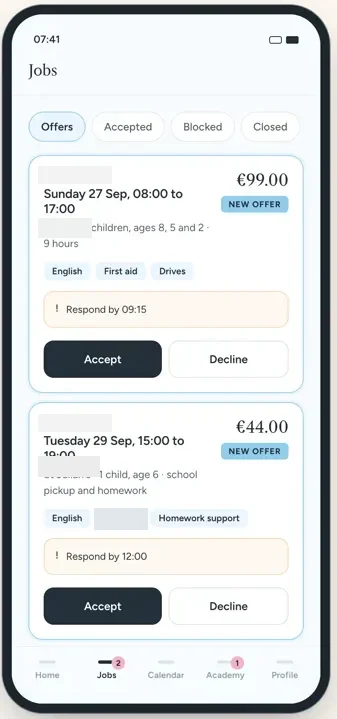
For a childcare agency we built a platform whose office screen opens with what needs action: documents to verify, documents about to expire and approvals waiting. Every change is saved in an audit log with a name and a time. A law firm needs the same shape: enquiries and conflict matches at the top, identity documents checked before work starts, and a record of who decided what. The case study shows what we built.
A few straight answers
A system that keeps every enquiry, client, related party, conflict search, decision and key date in one place, with an owner and a reply deadline for each new enquiry.
Yes. It searches the client, the other side and related parties against every past and present matter, then holds the enquiry until a partner clears any match.
The duties apply to advocates and their staff. Chapter VI asks you to keep client affairs confidential and make sure staff do the same, so access by role and an audit log help you show it.
Not for every matter. S.L. 373.01 covers advocates when they take part in certain transactions, such as buying or selling property or companies. For that work, records are kept for five years.
No. A CRM runs intake, clients and follow-ups. Case management runs documents, time and billing. Many firms use both, connected so a new matter opens without retyping.
It can collect details and book a call. It must say it is an AI system under Article 50 of the AI Act, and legal advice stays with your advocates.
Malta Digital builds custom CRM systems from €7,500. The price depends on your practice areas, users and the tools it connects to, with a written quote first.
Commission for the Administration of Justice: Code of Ethics and Conduct for Advocates (Chapters II, V and VI) · Chamber of Advocates: FAQs on the Code of Ethics · Laws of Malta: S.L. 373.01, Prevention of Money Laundering and Funding of Terrorism Regulations, regulations 2 and 13 · GDPR, Regulation (EU) 2016/679 (EUR-Lex) · AI Act Service Desk: Article 50, transparency obligations
Keep reading
How accounting firms in Malta use a CRM for enquiries, onboarding and due diligence, deadlines and document chasing, plus a free deadline and chasing planner.
How to run a GDPR-compliant CRM in Malta: lawful basis, marketing consent, EU hosting, access roles, retention, data requests and breaches, in plain steps.

A free, printable CRM setup checklist for Malta and Gozo businesses: 38 steps from choosing a CRM to data, GDPR, lead ads, launch and funding. Get the PDF.
A useful first step
Tell us how many enquiries you get, your practice areas and how you run conflict searches today. We reply with what we would build first and what a CRM that fits would cost.
Step 1 of 3
A few quick questions, about a minute. We usually reply within 2–3 hours.