B2B Ordering Portal in Malta: Let Trade Customers Reorder
A B2B ordering portal lets trade customers in Malta order and reorder 24/7 at their own prices. What it includes, options, EU rules and a savings calculator.
Systems & AI · CRM by industry
Malta Digital builds custom CRM systems in Malta, and wholesalers are among the firms that gain most. This guide shows what a CRM does for a distributor. It covers trade accounts, sales rep visits, reorder reminders, price agreements and credit control. It also has Eurostat data on Malta, the payment rules, a worked example and a free reorder planner.
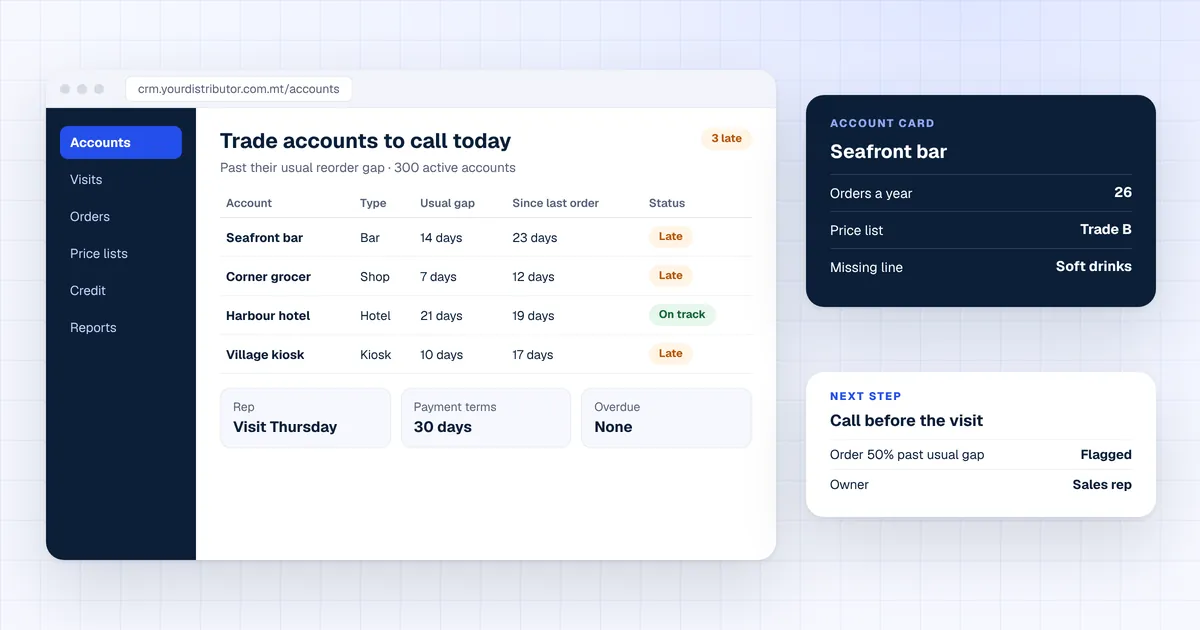
A CRM for wholesale distributors keeps every trade account in one place: contacts, price agreements, order history, rep visits and payment terms. It warns you when a regular customer has not reordered on time. In 2025, 45.3% of Maltese wholesalers with 10 or more staff used CRM software (Eurostat). Malta Digital builds CRM systems for distributors from €7,500.
The short version
A distributor sells the same products to the same trade customers, again and again. The money is in the reorders. A CRM makes sure none of them slips quietly away.
Every outlet, buyer, phone number and delivery address of a trade customer, together.
How often each account usually orders, and an alert when an order is late.
Who visits which account, when, and what was agreed, logged on a phone.
The agreed prices, discounts and terms for each account, in one place.
Payment terms, overdue invoices and credit limits shown before the next order.
Which products each account buys, and which ones it stopped buying.
Your accounts or ERP system keeps stock and invoices. The CRM keeps the relationship: who to call, why, and what happened last time. Our guide to ERP vs CRM explains the split.
Malta data
Eurostat asks firms with 10 or more staff every two years if they use CRM software. In 2025, 45.3% of Maltese wholesalers said yes, against 42.5% across the EU. That share was 48.5% in 2023.

So Malta is slightly ahead of the EU, but more than half of its wholesalers report no CRM software at all, and the share fell in two years. Without one, a lost customer often shows up only in the yearly totals.
Quiet accounts
Trade customers rarely announce that they are leaving. A bar that ordered every two weeks orders every four. Then a smaller order. Then nothing. By the time anyone notices, a competitor has the shelf.
The rule is simple. Each account gets its own usual gap between orders, worked out from its history. When an order is late by more than a set share of that gap, the account goes on the rep’s call list for that day.
To see what faster follow-up is worth across your whole book, try our CRM ROI calculator.
Apply now and tell us how many accounts and reps you have, and what you use today. We reply with what we would build first.
Free tool
Put in your trade accounts, how often they order, the average order and how many go quiet in a year. The planner works out the sales at risk and what early calls could win back. Nothing you type leaves this page.
Starting numbers match the worked example below. Replace them with yours.
Your result appears here as you type.
Payment terms
Sales and credit control often work from different screens. A rep takes a big order from an account that is already 90 days overdue. A CRM shows the payment status on the account before the order is taken.
| Rule | What it says | What the CRM does |
|---|---|---|
| Commercial Code, art. 26C(3) | No date agreed? Interest runs 30 days after the invoice arrives | Uses 30 days when an account has no agreed terms |
| Commercial Code, art. 26C(4) | Agreed payment terms may not go past 60 days, unless expressly agreed and not grossly unfair | Flags any account set up with terms over 60 days |
| Commercial Code, art. 26C(1) and (2) | Interest is due without sending a reminder first | Shows overdue days and interest due on the account |
| Statutory rate, July to December 2026 | 10.40% a year in Malta (ECB rate plus 8 points) | Uses the rate for the half year of the due date |
| Recovery costs, art. 26E | At least €40 for each invoice paid late | Adds the €40 line when a reminder goes out |
For the full rules, with a late interest calculator, read our guide to late payment interest in Malta.
The workflow
Here is how the account life cycle runs in a distributor’s CRM.
Before you choose a system, our CRM setup checklist lists what to agree first, and the CRM quiz shows which kind of CRM fits.
Worked example
Here is an example distributor, not a client. It supplies 300 bars, shops and hotels, and each account orders about 18 times a year at €450 an order. These are the planner’s starting numbers, so you can change them.
| Item | Number | How it is worked out | Result |
|---|---|---|---|
| Accounts that go quiet in a year | 8% of 300 | 300 × 8% | 24 accounts |
| Sales from one account a year | 18 orders at €450 | 18 × €450 | €8,100 |
| Sales at risk from quiet accounts | 24 accounts | 24 × €8,100 | €194,400 a year |
| Won back with early calls | 25% of them | 24 × 25% × €8,100 | about €48,600 a year |
The point is not the exact figure. It is that a few quiet accounts a month, caught early, are worth more than most new ones you could win.
Your options
A monthly fee per user. Good for contacts, visits and deals. Price lists and reorder rhythm often need workarounds.
Best for: A small team that mainly needs visit notes and tasks.
Shares stock and invoices with your accounts system. Often harder to use on a rep’s phone.
Best for: Firms already on an ERP that has one.
Built around your accounts, price agreements, reorder rules and reps, connected to your accounts system and portal.
Best for: Distributors with many accounts, outlets and price lists.
For what each route costs over time, see our guide to how much a CRM costs. Firms that also deliver can add routes and drivers, as in our guide to a logistics CRM.
Proof
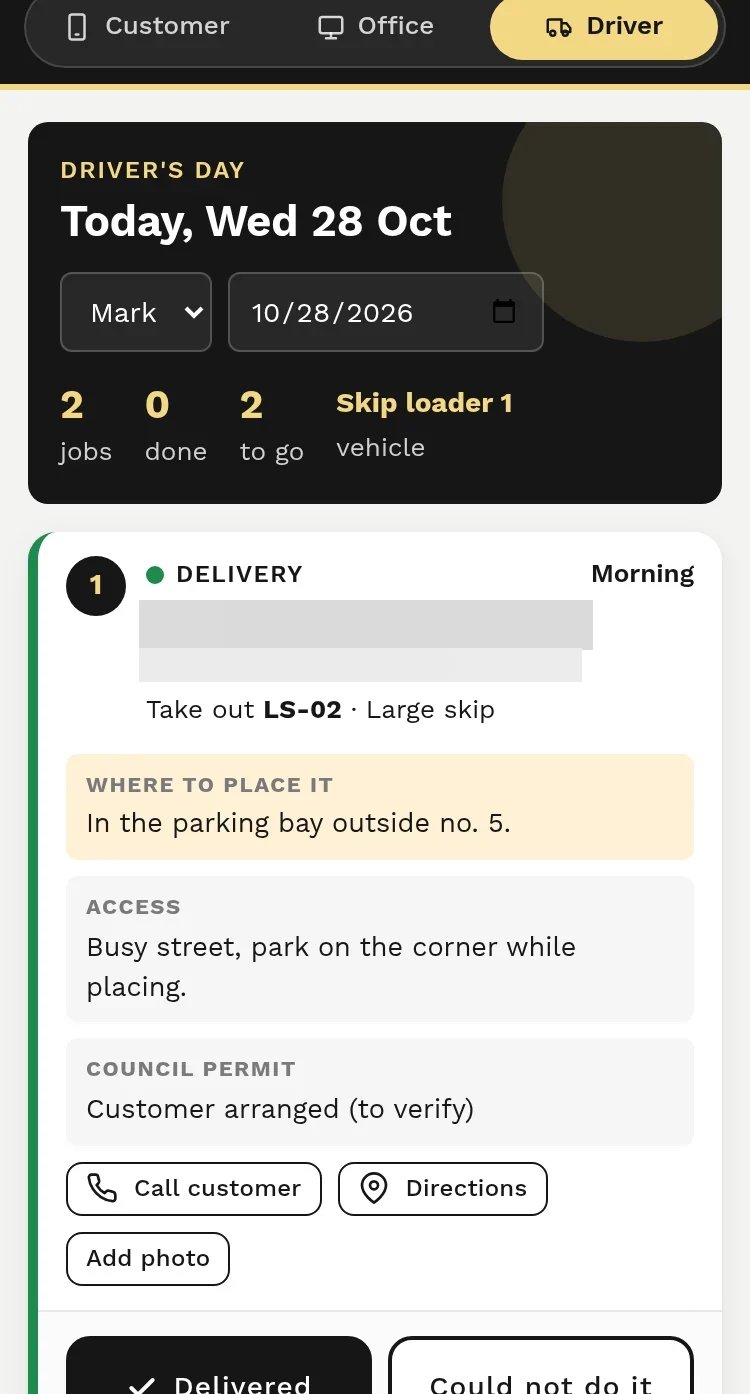
For a skip hire business we built a booking and dispatch system with a driver view. Drivers see the day’s jobs in order, with the address, access notes and permit status, then mark each one delivered or give a reason. Problems go straight back to the office. A distributor needs the same loop for its reps and drivers: today’s visits in order, notes logged on the spot, and the office seeing the result at once. The case study shows the screens.
A few straight answers
A system that keeps every trade account in one place: outlets, buyers, price agreements, order history, rep visits and payment terms, with alerts when an account stops ordering.
In 2025, 45.3% of Maltese wholesalers with 10 or more staff used CRM software, against 42.5% in the EU, according to Eurostat. In 2023 the Malta share was 48.5%.
It works out each account’s usual gap between orders from its history. When the next order is late by more than a set share of that gap, the account goes on the rep’s call list.
No. The ERP keeps stock, invoices and payments. The CRM keeps accounts, visits and follow-ups, and reads order and payment data from the ERP.
Under article 26C of the Commercial Code, agreed terms between businesses may not go past 60 days, unless expressly agreed and not grossly unfair. With no agreed date, interest runs 30 days after the invoice arrives.
Yes. Reps see their accounts and visits for the day, log notes and orders on the spot, and the office sees them at once.
Malta Digital builds custom CRM systems from €7,500. The price depends on your accounts, users, price lists and the systems it connects to, with a written quote first.
Keep reading
A B2B ordering portal lets trade customers in Malta order and reorder 24/7 at their own prices. What it includes, options, EU rules and a savings calculator.
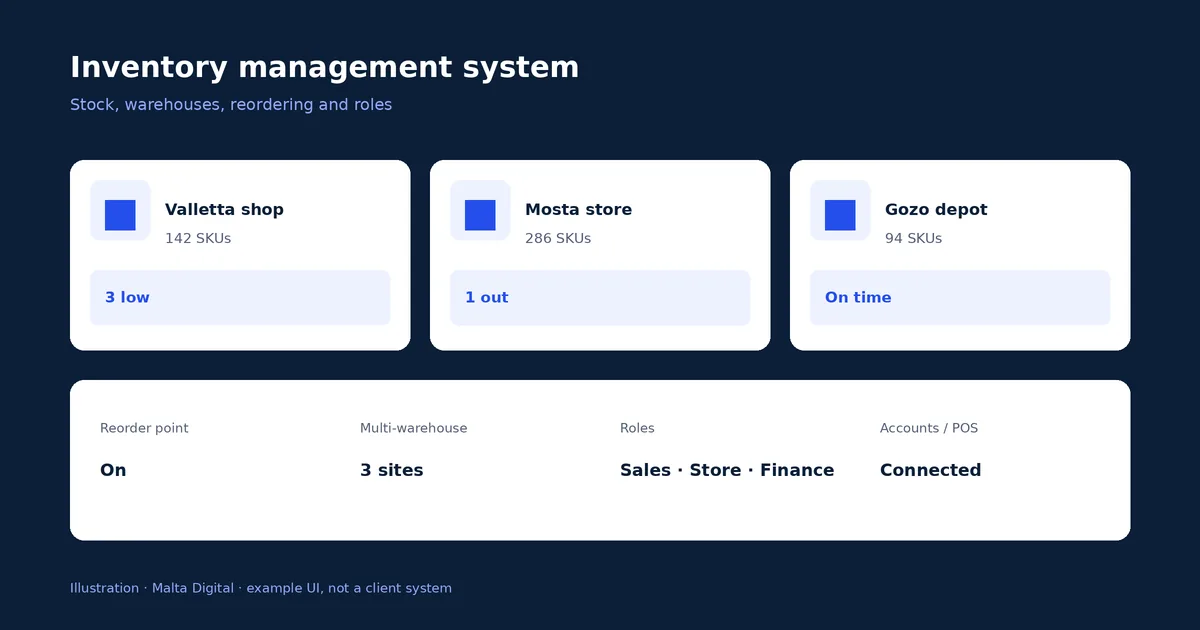
What an inventory management system does, when custom beats ready-made, and how multi-site stock, roles and reporting fit a Malta business system.
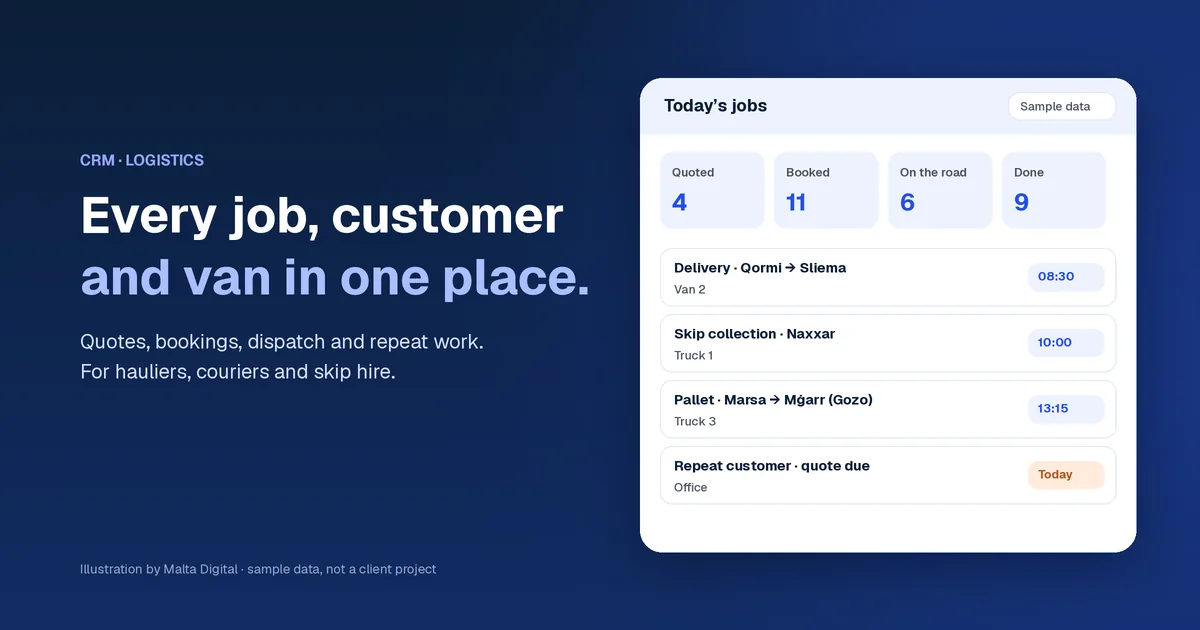
What a logistics CRM does for hauliers, couriers and skip hire in Malta: quotes, jobs, dispatch, proof and repeat orders, with official data. From €7,500.
A useful first step
Tell us how many trade accounts and reps you have, how orders come in and what you use today. We reply with what we would build first and what a CRM that fits would cost.
Step 1 of 3
A few quick questions, about a minute. We usually reply within 2–3 hours.